




Seeing the Invisible
For centuries, the very beginning of a star’s life was shrouded in mystery, hidden behind impenetrable clouds of cosmic gas and dust. These stellar nurseries, while dense with the raw materials for new suns and planets, are opaque to telescopes that see
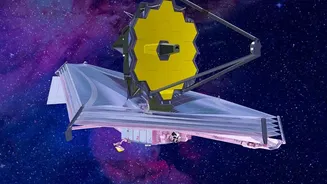
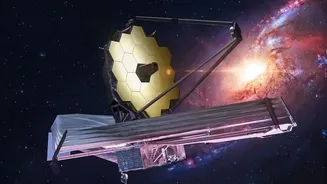
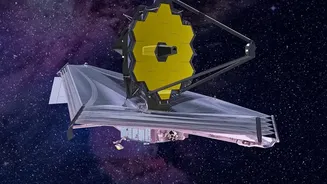
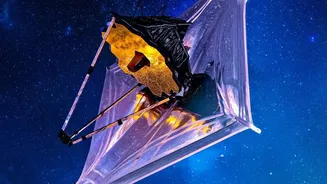
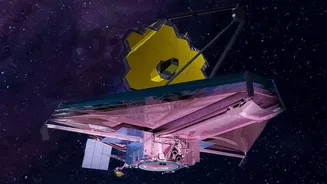
in visible light, like the Hubble. The James Webb Space Telescope, however, is engineered to see the universe in infrared. This longer wavelength of light can pass through the thick dust, much like how infrared cameras can see through smoke. The result is a stunning and unprecedented look directly into the cradles of creation. For the first time, astronomers aren't just looking at the evidence left behind; they are witnessing the birth of stars and planetary systems in near real-time.
A Gallery of Cosmic Cribs
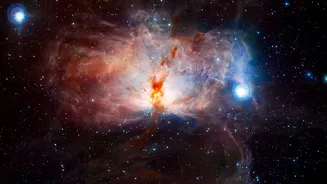
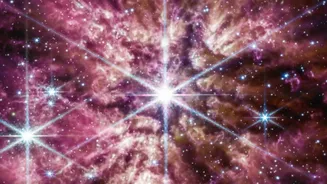
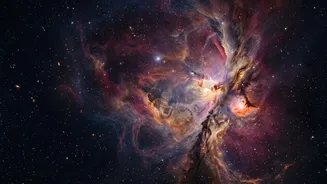
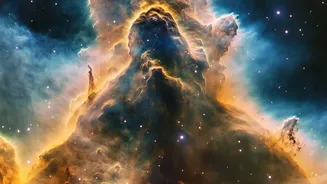
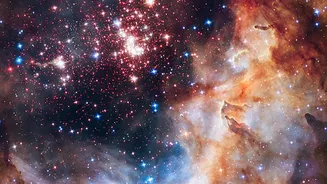
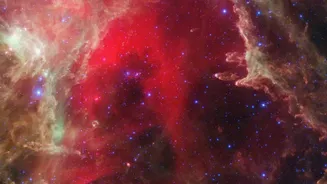
Recent observations have targeted several star-forming regions, each offering unique insights. In a region called W51, JWST unveiled massive young stars, hidden until now, that began forming within the last million years. In the stunning Lobster Nebula, thousands of sparkling newborn stars were revealed, their intense radiation and stellar winds carving out vast cavities in the surrounding gas. One of the most captivating images is of a protostar within a dark cloud named L1527. Seen in infrared, it resembles a fiery hourglass. The star itself, just 100,000 years old, is a tiny clump of gas at the hourglass’s narrow neck. The glowing ‘glass’ of the hourglass is created by material being ejected from the protostar, colliding with and illuminating the surrounding dust. At the center, a dark line reveals a protoplanetary disk—a spinning belt of dust and gas that will one day coalesce into planets, much like our own solar system once did.
Rewriting the Story of Stars
These images are more than just beautiful cosmic portraits; they are rich data sets that are revolutionizing astrophysics. For instance, the formation of massive stars has been poorly understood compared to their smaller cousins like our Sun. Webb's ability to peer into dense clusters like Sagittarius B2, the most active star-producing region in our galaxy, is finally providing clear views of these giants coming to life. In another case, the telescope examined an object called Herbig-Haro 797 and discovered that what was believed to be a single, rotating jet of gas was actually two parallel outflows from a pair of binary stars forming together. This confirms that many, if not most, stars are born with a companion. These details help scientists refine their models of how stars gather mass, interact with their environment, and ultimately influence the evolution of their host galaxies.
From Cosmic Dust to Our Solar System
Studying these stellar nurseries also helps us answer fundamental questions about our own origins. Observations of the protostar EC 53 in the Serpens Nebula have provided the first direct evidence of how crystalline silicates—minerals that need intense heat to form—get transported from the hot inner region of a star’s disk to the cold outer reaches. This helps explain a long-standing mystery: why comets from the frigid edge of our own solar system contain these heat-forged crystals. By watching these processes unfold hundreds of light-years away, we gain a clearer picture of the conditions that existed when our Sun and Earth were formed 4.6 billion years ago. As one scientist noted, Webb allows us to see the beginning of another star's story, giving us a glimpse into a phase our own sun experienced long ago.