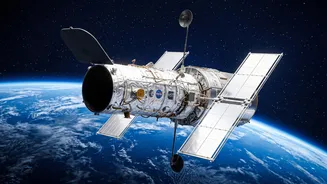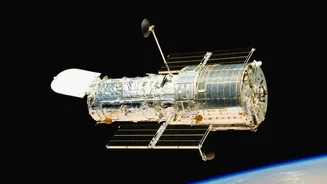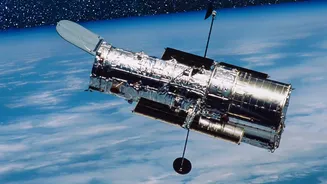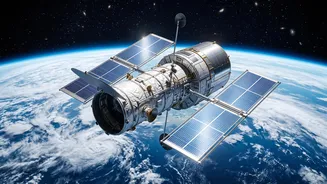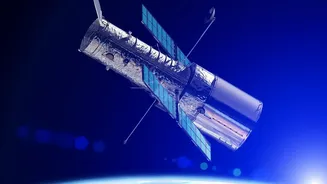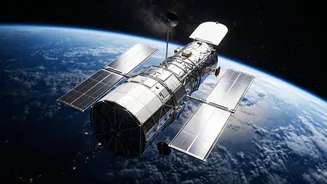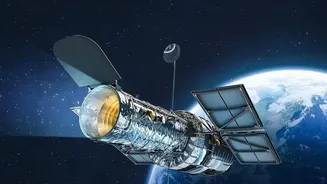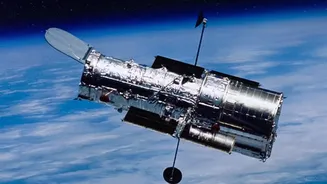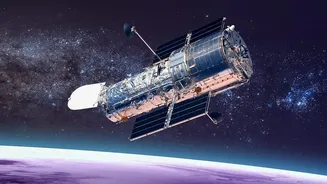





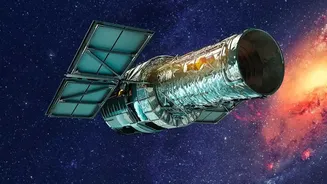
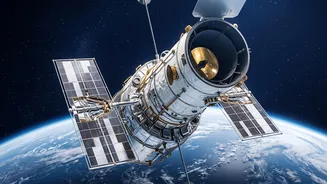
For over three decades, the Hubble Space Telescope has been humanity's eye on the cosmos. But its time may be running out as its orbit decays. Now, NASA is turning to the commercial space industry for innovative ideas to give it a life-extending lift.
Why Hubble Needs a Boost
Like any object in low-Earth orbit, the Hubble Space Telescope is subject to atmospheric drag. Even in the thin atmosphere hundreds of miles up, tiny particles create a gentle but persistent friction, causing the telescope to gradually lose altitude. Since its launch in 1990, Hubble's orbit has been periodically raised during Space Shuttle servicing missions, but the last such boost was in 2002. Without its own propulsion system, Hubble has been slowly sinking ever since. Current projections estimate that without intervention, the iconic observatory could make an uncontrolled re-entry into Earth's atmosphere sometime between 2033 and 2034. This would not only end its historic scientific mission but also pose a potential risk, as parts of the large telescope might survive re-entry.
NASA's Call for Commercial Ideas
Recognizing the urgency, NASA issued a formal Request for Information (RFI) in late October 2026. This RFI is not a contract for a mission but an open call to the burgeoning commercial space sector for concepts and data. The agency is exploring three main possibilities: a mission to reboost Hubble to a higher, more stable orbit; a servicing mission to enhance its capabilities; or a mission to guide it to a safe, controlled disposal at the end of its life. By asking for industry input, NASA is tapping into a new era of spaceflight, where private companies have developed capabilities for rendezvous, docking, and in-space servicing that did not exist during the Shuttle era. Responses are due by the end of November 2026, giving the agency a chance to assess the feasibility, cost, and risk of various private-sector solutions.
Who Could Answer the Call?
The most prominent name in the conversation is SpaceX. In 2022, the company, in partnership with billionaire Jared Isaacman's Polaris Program, signed an unfunded agreement with NASA to study the feasibility of using a Dragon spacecraft to dock with and reboost Hubble. While that initial effort did not move forward, the new RFI reopens the door for this and other proposals. Isaacman, now the NASA Administrator as of late 2025, has expressed a commitment to exploring all 'innovative and cost-effective ways' to extend the telescope's life. Other companies specializing in robotics and in-orbit servicing are also expected to show interest, potentially offering robotic 'tug' spacecraft that could perform the mission without a human crew. The RFI makes clear that any proposed mission, whether crewed or robotic, would need to be launched by 2032 to be effective.
The Prize: More Years of Science
Saving Hubble is about more than just preserving a historical icon; it's about extending its unique scientific contributions. Hubble's ability to observe the universe in visible and ultraviolet light is a capability not replicated by the newer James Webb Space Telescope, which is primarily an infrared observatory. Astronomers argue that losing Hubble would create a significant gap in our observational capabilities until a successor, the Habitable Worlds Observatory, is potentially launched in the 2040s. A successful reboost to an altitude of 600 kilometers could add another 15 to 25 years of operational life to the telescope. This would mean hundreds of thousands of additional observations and the potential for new, groundbreaking discoveries about our universe. The mission would also serve as a landmark demonstration of commercial in-space servicing, paving the way for maintaining other valuable assets in orbit.