






Unveiling the Celestial Nursery
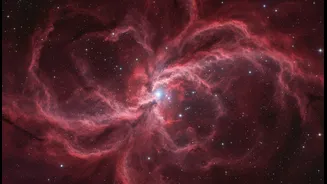
The subject of this stunning new photograph from the Hubble Space Telescope is a stellar nursery officially known as LH 95. Located in the Large Magellanic Cloud, a dwarf galaxy that orbits our own Milky Way, LH 95 is a vast region of gas and dust where
new stars are actively being born. The nickname 'Crimson Cloud' comes from the image's most striking feature: a massive, glowing expanse of red gas. This is not a formal designation but a descriptive name that perfectly captures the visual essence of this cosmic landscape. Such regions are vital for our understanding of astrophysics, as they provide a direct look at the chaotic and beautiful process of stellar formation, offering clues about how stars, including our own Sun, came into existence.
The Science Behind the Crimson Glow
The brilliant red hue is not just for show; it is a tell-tale sign of intense stellar activity. The cloud is predominantly made of hydrogen gas. Within this nursery, massive young stars, some many times larger than our Sun, burn fiercely. These giant stars unleash powerful ultraviolet radiation and stellar winds that energize the surrounding hydrogen atoms. As the hydrogen gas gets heated, it emits light in a very specific red wavelength known as hydrogen-alpha. The Hubble telescope's filters are designed to capture these different wavelengths, and astronomers then assign colors to them to make the scientific data visible to the human eye. In this case, the prominent red represents the tell-tale glow of star birth. The brilliant specks of blue and white are the hot, young stars responsible for illuminating their cosmic cradle.
A Laboratory for Star Formation
Beyond its beauty, LH 95 is a priceless natural laboratory for astronomers. It offers a relatively clear view of star formation, with less of the obscuring dust that often shrouds similar regions within the Milky Way. This clarity has allowed researchers to identify an extraordinary population of around 2,500 'pre-main-sequence' stars. These are stellar infants that have gathered most of their mass from the surrounding gas and dust but have not yet ignited the nuclear fusion process in their cores that would make them true stars. By studying this large group of developing stars at various stages, scientists can test and refine their theories about how stars grow. Recent studies of LH 95 confirmed a key hypothesis: the rate at which a young star pulls in new material, known as its accretion rate, decreases as the star gets older.
Hubble's Enduring Power
The image of the Crimson Cloud is also a testament to the enduring power of the Hubble Space Telescope. Launched in 1990, Hubble has been humanity's eye on the universe for over three decades, revolutionizing nearly every area of astronomy. While newer instruments like the James Webb Space Telescope now probe the cosmos in different ways, primarily in infrared light, Hubble continues to provide invaluable data in visible and ultraviolet wavelengths. The work of these great observatories is often complementary, with one telescope's findings enhancing the other's. The fact that Hubble can still produce images and data of this quality and scientific importance highlights its incredible design and the success of its servicing missions. It remains a critical tool for exploring the wonders of the cosmos.