





The Growing Junkyard Above Our Heads
For decades, we have been launching satellites, rockets, and probes into space. While these have revolutionised communications, science, and navigation, they have also created a significant problem: space debris. From defunct satellites to spent rocket stages
and even smaller fragments from collisions, hundreds of thousands of objects are currently whipping around our planet at incredible speeds. This orbital congestion poses a serious threat to the thousands of active satellites we rely on for everything from GPS to weather forecasting. A collision with even a small piece of debris can be catastrophic, destroying a valuable asset and creating thousands more pieces of dangerous junk. This has led to the 'launch-and-abandon' model, where satellites are simply left to drift once their operational life ends.
A Close-Up Look at the Challenge
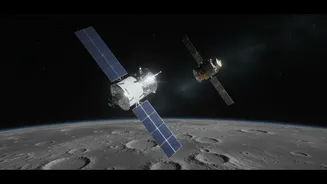
Cleaning up this mess is not as simple as sending up a cosmic garbage truck. A major hurdle has been the ability to safely approach a piece of debris that was never designed to be touched. These objects are often tumbling uncontrollably, have unknown structural integrity, and lack any kind of docking port or grapple fixture. The first step to solving this is mastering what engineers call Rendezvous and Proximity Operations (RPO). This involves a servicing spacecraft carefully manoeuvring to get extremely close to another object, matching its orbit and speed precisely. Several missions are tackling this, with companies like Astroscale recently demonstrating the ability to approach and inspect a large piece of debris with its ADRAS-J mission, and the U.S. Naval Research Laboratory's RSGS payload launching to demonstrate servicing of satellites in geosynchronous orbit.
Success in a Delicate Dance
The latest breakthrough revolves around proving these RPO capabilities can work reliably on an 'uncooperative' target. Missions like ADRAS-J have successfully flown around a target, taking detailed images and gathering data. This inspection phase is crucial; it allows the servicer to understand the object's rotation, identify potential hazards, and plan a safe approach for a future capture mission. Think of it as a bomb disposal robot carefully examining a package before trying to disarm it. By proving that a robotic spacecraft can safely get 'eyes on' a piece of tumbling debris, engineers have removed a massive variable from the equation. It's the critical first step that makes all subsequent actions—like capturing, repairing, or de-orbiting—possible.
What This Means for the Future of Space
This success is about more than just debris removal. It unlocks the door to a whole new in-orbit economy. The same RPO technologies can be used for satellite life extension, where a servicing vehicle could dock with a satellite to refuel it, repair a malfunctioning part, or even install upgraded components. This could dramatically lower the cost of space operations, as companies would no longer need to launch a brand-new satellite every time one runs out of fuel or suffers a minor failure. It moves the industry away from a disposable model to a sustainable one. Companies are now developing missions designed to capture and move satellites, with follow-on projects already planned to attempt the physical removal of debris based on the success of these initial inspection missions.