



Peeking Inside Stellar Nurseries
One of the most fundamental processes in the cosmos is the birth of stars, but for a long time, it was shrouded in mystery, literally. Stars form inside dense clouds of gas and dust that block visible light, making it impossible for telescopes like Hubble
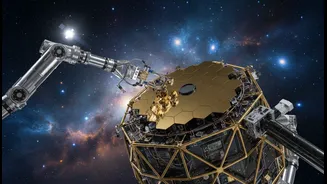
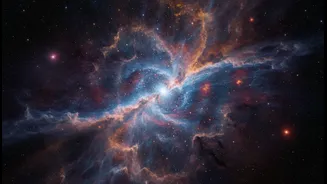
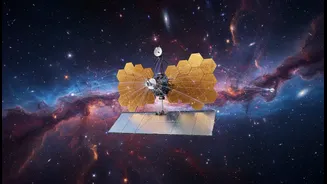
to see inside. This is where the James Webb Space Telescope (JWST) has changed the game. By looking at the universe in infrared light, JWST can peer through these dusty curtains. Recent images of stellar nurseries, like the stunning new views of the Carina Nebula or the Pillars of Creation, reveal fledgling stars in incredible detail. For a beginner, this turns an abstract concept into a visual story. You can see the glowing pockets where gas is collapsing to form protostars and the powerful jets of energy blasted out by young, energetic stars. It’s a direct look at the cosmic cycle of birth, showing how the raw materials of the galaxy are recycled into new suns and, eventually, new planets. These images make it clear that the universe is not static but a dynamic and ever-changing place.
Mapping the Invisible Universe
Scientists believe that over 95% of the universe is made of dark matter and dark energy, stuff we cannot see or directly detect. So how do you study something that's invisible? You map what you can see. This is the primary mission of the European Space Agency's (ESA) Euclid telescope. Recent data from Euclid, and complementary large-scale surveys from JWST, are creating the most detailed 3D maps of the universe ever made. These maps show how countless galaxies are arranged not randomly, but in a vast, interconnected structure of filaments and voids known as the cosmic web. For someone new to cosmology, this is a powerful visual aid. By observing how galaxies are clustered together and how their light is bent and distorted as it travels to us—a phenomenon called gravitational lensing—scientists can infer the presence of the invisible dark matter that acts as the universe's scaffolding. Seeing these vast maps helps a beginner grasp the immense scale of the cosmos and understand how astronomers can study the unseen by observing its gravitational effects on the visible.
Using Galaxies as Time Machines
One of the most mind-bending ideas in astronomy is that looking at distant objects is the same as looking back in time. Light travels at a finite speed, so the light from a galaxy a billion light-years away has taken a billion years to reach us. Telescopes, therefore, are time machines. JWST was specifically designed to be the most powerful time machine ever built. Recent deep-field images, which capture thousands of galaxies in a patch of sky the size of a grain of sand held at arm's length, show galaxies as they existed over 13 billion years ago, when the universe was in its infancy. For a beginner, this is a profound revelation. The small, red smudges in these images are some of the first galaxies ever formed. By studying their shape, size, and color, astronomers can piece together the story of how galaxies evolve, from small, chaotic beginnings to the grand spirals we see today. It’s a visual lesson in cosmic history, showing us that the universe has a story and we are only now seeing its earliest chapters.
Decoding the Skies of Alien Worlds
For centuries, the question of whether we are alone in the universe has been a philosophical one. Now, it's becoming a scientific one, thanks again to the JWST. The telescope is powerful enough to do something truly remarkable: analyze the chemical composition of atmospheres on exoplanets, or worlds orbiting other stars. Recent studies have provided stunning insights. For instance, astronomers used JWST to study a world 57 light-years away, finding evidence of water vapor, methane, and even exotic salty clouds. This is done by a technique called transit spectroscopy. When a planet passes in front of its star, a tiny fraction of the starlight filters through its atmosphere. By analyzing which wavelengths of light are absorbed, scientists can identify the gases present. For a beginner, this makes the search for alien life tangible. We are no longer just guessing; we are collecting data. While we haven't found aliens, the ability to detect the building blocks of life on distant worlds transforms the search from science fiction into a real, data-driven quest.