

A Cosmic Surprise
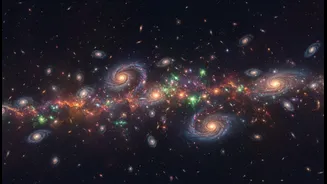
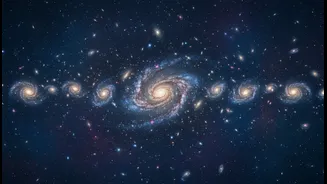
A recent wave of astronomical studies has unveiled that some of the first galaxies were not the formless blobs scientists once imagined. Using the powerful James Webb Space Telescope (JWST), researchers have spotted remarkably well-organized structures
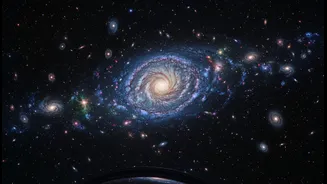
in galaxies that existed when the universe was in its cosmic dawn. One recent study from Durham University identified the most distant known 'nuclear disc' — a dense, rotating disc of stars at the heart of a galaxy — seen as it was just 4.5 billion years after the Big Bang. This structure appears to have been built by a long, bar-shaped formation of stars, a feature common in modern galaxies like our own Milky Way but previously unheard of so early in cosmic history. Another study from India's Inter-University Centre for Astronomy and Astrophysics (IUCAA) found that galaxies less than a billion years after the Big Bang already followed a fundamental architectural rule known as the Kormendy relation, which links a galaxy's size to its brightness. Both findings suggest an unexpected maturity.
The Old Picture: Primordial Chaos
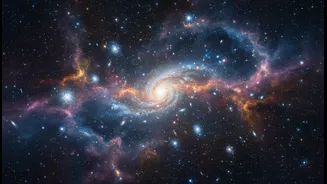
These new discoveries directly challenge long-held theories of galaxy formation. The standard model, often called the 'bottom-up' or hierarchical theory, proposed that the first galaxies were small, irregular, and chaotic. They were thought to have formed from tiny fluctuations in density in the early universe, slowly growing by pulling in gas and merging with other small, clumpy proto-galaxies over billions of years. According to this model, well-defined structures like spiral arms, rotating discs, and stellar bars should have taken a very long time to develop. The early universe was seen as a frantic construction site, with galaxies only settling into their elegant, ordered forms much later. The latest findings, however, suggest that the blueprints for these structures were in place far sooner than anyone predicted.
A New Eye on the Dawn of Time
This radical rewriting of cosmic history is made possible by the James Webb Space Telescope. Launched in 2021, the JWST is the most powerful space telescope ever built, with unprecedented sensitivity to infrared light. Because the expansion of the universe stretches light from distant objects to longer, redder wavelengths, Webb can see farther back in time than any previous observatory. This allows astronomers to capture light from galaxies that formed in the universe's first billion years. Before Webb, telescopes lacked the sensitivity and resolution to study anything but the brightest and most exceptional objects at such distances. Now, researchers can resolve the internal structures of these ancient galaxies, moving from studying a few examples to analyzing hundreds, and what they're finding is that the universe learned the rules of galaxy-building very early on.
Rewriting the Textbooks
The implications of this newfound order are profound. It means the physical processes that shape galaxies into stable, organized systems were at work much earlier and more efficiently than previously thought. Stellar bars, for example, are not just cosmetic features; they act like cosmic conveyor belts, funneling gas and stars toward the galactic center, fueling star formation, and potentially feeding the supermassive black holes that lurk there. Discovering them so early suggests that the mechanisms for rapid galaxy growth and maturation were already active. These findings provide a new benchmark for galaxy formation theories. Computer simulations will now need to explain not just how massive galaxies formed so quickly, but also why they were so well-behaved, following the same structural laws that govern galaxies nearly 13 billion years later.