

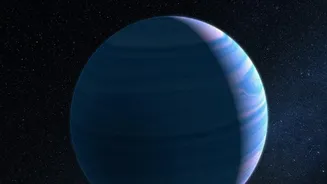


Imagine discovering a new planet, only for it to vanish years later. This is what happened with Fomalhaut b, a celestial object 25 light-years away. It was a cosmic magic trick that left astronomers baffled, but a closer look has finally revealed the
truth.
The Groundbreaking Discovery
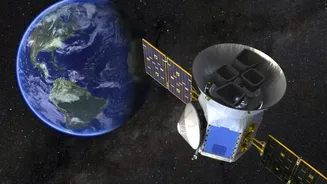
In 2008, the astronomical community was buzzing with excitement. Using the Hubble Space Telescope, scientists announced the first-ever direct visual evidence of a planet orbiting another star. Named Fomalhaut b, and later Dagon, the object appeared as a distinct dot of light moving around the bright star Fomalhaut. This was a monumental achievement. For years, exoplanets had been detected indirectly, through methods like observing the wobble of a star or the dip in its light as a planet passed in front. Seeing one directly was a game-changer, offering a new window into how planetary systems form. Initial estimates suggested it was a massive world, perhaps up to three times the mass of Jupiter, on a long, 1,700-year orbit.
A Puzzle Emerges
Almost immediately, Fomalhaut b started showing strange behaviour. For a planet of its supposed size, it was unusually bright in visible light but had no detectable heat signature in the infrared spectrum, which was a major red flag. Young, large planets should be warm enough to glow in infrared light. Astronomers initially theorised that perhaps the planet was surrounded by a massive ring or shell of dust that was reflecting starlight, making it appear brighter than it was. Furthermore, its orbit was highly unusual and seemed to be on a path that would take it through a vast, icy debris ring without gravitationally disturbing it—something a massive planet should definitely do. It was, as one astronomer put it, doing things a 'bona fide planet should not be doing'.
The Disappearing Act
The mystery deepened over the next decade. As astronomers continued to track Fomalhaut b using Hubble, they noticed it was gradually fading. Then, in images taken in 2014, the planet was gone. It had completely vanished from sight. A planet simply does not disappear. This shocking development sent researchers back to the drawing board, forcing them to re-evaluate every piece of data they had collected since 2004. The leading theory was no longer about a quirky planet, but something far more dramatic. The evidence now painted a picture that the planet-sized object might never have existed at all.
The Truth Revealed: A Cosmic Smashup
The solution to the mystery was not a missing planet, but the ghostly aftermath of an epic collision. The 'closer analysis' involved studying all available Hubble data, which revealed that the object was not a solid body but an expanding cloud of fine dust. Scientists now believe that shortly before the first observation in 2004, two large celestial bodies, likely icy planetesimals each about 200 kilometres across, slammed into each other. The bright dot seen by Hubble was the incredibly rare sight of the immediate aftermath of this cataclysmic event. The cloud of fine dust particles, each smaller than the diameter of a human hair, brilliantly reflected the light from the parent star, masquerading as a planet. Over the years, this cloud expanded and dissipated, spreading out over an area larger than Earth's orbit, until it became too faint and diffuse for Hubble to detect.