


The hunt for the chemical building blocks of worlds beyond our own has taken another leap forward. Finding carbon dioxide in the atmospheres of strange, distant objects offers a tantalizing glimpse into the chemistry of how planets and stars are born.
The 'Failed Stars' of the Galaxy
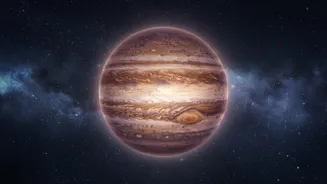
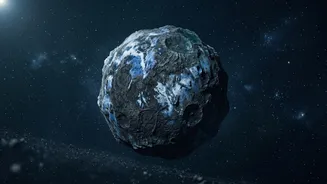
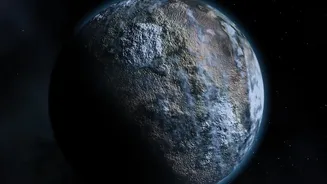
Imagine an object floating alone in the darkness of space, something much bigger than Jupiter but not quite massive enough to become a star. This is a brown dwarf. Often called 'failed stars', these celestial bodies form from collapsing clouds of gas and dust, just like stars do. However, they never accumulate enough mass to kickstart the nuclear fusion of hydrogen in their cores, the process that makes stars like our sun shine brightly. Instead, they glow faintly from the residual heat of their formation, slowly cooling over billions of years. Brown dwarfs occupy a fascinating middle ground between giant planets and small stars, making them perfect laboratories for studying atmospheric chemistry in conditions unlike anything in our solar system.
Reading a Chemical Fingerprint in the Dark
Scientists can't visit a brown dwarf to sample its atmosphere. Instead, they rely on a technique called spectroscopy. When light from a celestial object passes through its atmosphere, different molecules absorb specific wavelengths, or colours, of that light. By capturing the remaining light with a powerful telescope and splitting it into a rainbow-like spectrum, astronomers can see which wavelengths are missing. These missing slivers act as a chemical fingerprint, revealing the presence of molecules like water, methane, and carbon dioxide. This method allows scientists to analyze the composition of worlds light-years away without ever leaving home.
A New Generation of Cosmic Explorers
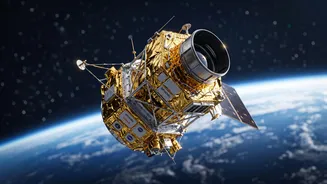
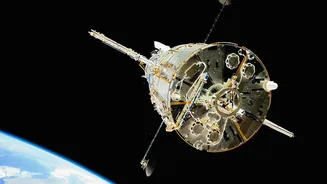
While the headline points to NASA's SPHEREx telescope, the reality is a story of teamwork among advanced observatories. SPHEREx, which launched in March 2025, is a powerful new tool designed to scan the entire sky multiple times, creating a comprehensive map in 102 different colours of infrared light. Its mission includes finding the chemical ingredients for life and studying millions of galaxies. Recent discoveries of carbon dioxide and other molecules in brown dwarf atmospheres have actually been made by NASA's James Webb Space Telescope (JWST). Webb can study individual objects in incredible detail, while SPHEREx's strength lies in its ability to survey thousands of them, allowing scientists to understand what is common and what is rare. Together, they provide a fuller picture of the cosmos.
Why Finding Carbon Dioxide Is a Big Deal
On Earth, we often associate carbon dioxide with climate change, but in the context of a brown dwarf, its presence tells a very different story. Finding CO2, alongside other molecules like carbon monoxide, water, and methane, helps scientists piece together the object's history and formation. The relative amounts of these carbon- and oxygen-bearing molecules provide clues about the temperature, pressure, and chemical processes happening deep inside the atmosphere. It's important to note that discovering CO2 does not imply the presence of life. Rather, it's a fundamental ingredient that helps scientists test their models of how planetary and stellar objects form and evolve across the galaxy.
Piecing Together the Cosmic Puzzle
Each brown dwarf atmosphere we analyze is another piece of a grand cosmic puzzle. By comparing the chemical makeup of many different brown dwarfs, scientists can identify trends and anomalies that challenge their understanding of atmospheric physics. For example, observing how the balance between carbon monoxide and methane shifts at different temperatures helps refine models of atmospheric chemistry. Discoveries made by telescopes like Webb and SPHEREx provide crucial data points that confirm some theories and force a rethink of others. This ongoing work is not just about understanding these dim, isolated worlds; it's about building a more complete and accurate story of how all celestial bodies, including planets like our own, come to be.