



A New Guest in the Cosmic House
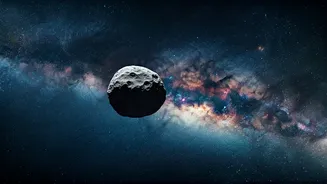
Astronomers operating the Asteroid Terrestrial-impact Last Alert System (ATLAS) first spotted the faint point of light. Initially, it looked like any other new comet or asteroid. The ATLAS system, with its telescopes in Hawai'i, Chile, and South Africa,
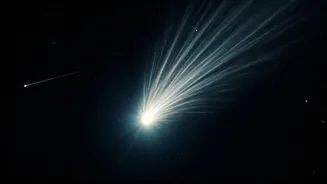
scans the entire night sky, looking for moving objects. Its job is to find asteroids that might pose a threat to Earth, but in doing so, it sometimes stumbles upon marvels. After cross-referencing with other observatories and plotting its initial path, a thrilling realisation dawned: this object's trajectory didn't originate from within our solar system. The International Astronomical Union (IAU), the official naming body, designated it 3I/ATLAS, with the 'I' confirming its status as the third-ever observed interstellar object.
The Telltale Hyperbolic Path
How can scientists be so sure it's an alien visitor? The answer lies in its path. Objects belonging to our solar system, from the smallest asteroids to the giant planets, travel in closed, elliptical orbits around the Sun. They are gravitationally bound to our star. This new object, 3I/ATLAS, is different. It is travelling on a hyperbolic trajectory. Think of it like this: if you throw a ball in the air, it follows an arc and comes back down, bound by Earth's gravity. But a rocket powerful enough to exceed escape velocity will leave Earth and never return. 3I/ATLAS is moving so fast that the Sun's gravity can bend its path, but not capture it. It will swing through our system once and then continue its journey back into the vastness of interstellar space, never to return.
Following in Famous Footsteps
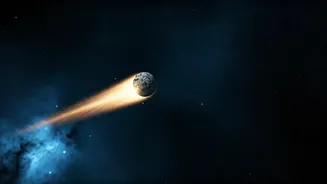
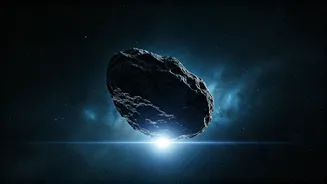
3I/ATLAS is not the first interstellar wanderer we've met. In 2017, the bizarre, cigar-shaped object named 'Oumuamua (1I) became the first confirmed interstellar visitor, puzzling scientists with its rocky appearance and strange, elongated shape. Then in 2019 came 2I/Borisov, which looked and acted much more like a familiar comet. It had a visible cloud of gas and dust, called a coma, and a tail, which allowed scientists to study its composition. 2I/Borisov was found to be incredibly rich in carbon monoxide, far more than typical comets from our own system, suggesting it formed in a very different and much colder environment, perhaps around a red dwarf star. Each new visitor provides another data point, helping us understand the diversity of building blocks in other star systems.
What Can This Newcomer Tell Us?
Every interstellar object is a cosmic message in a bottle, a precious sample of material from another star's planetary system. By studying the light reflected from 3I/ATLAS and analysing any gas or dust it releases as it warms near the sun, astronomers can decipher its chemical makeup. Is it rocky and dense like 'Oumuamua, or is it an icy snowball like 2I/Borisov? Does it contain familiar elements, or will it surprise us with an exotic composition, hinting at a very different kind of planetary nursery? These visitors are our only direct way to sample the chemistry of exoplanetary systems. They provide ground truth for our theories about how planets form not just here, but across the Milky Way.
An Era of Interstellar Discovery
For centuries, we thought our solar system was an isolated island. Now, we know we have regular passers-by. The discovery of three interstellar objects in just a few years is no accident. It's the result of new, powerful survey telescopes like ATLAS and its predecessors that can scan huge swathes of the sky more frequently and to fainter magnitudes than ever before. Scientists believe that at any given moment, there are likely thousands of these objects passing through our solar system, most too small and distant to see. As new observatories like the Vera C. Rubin Observatory come online, we expect to find not just one interstellar object every few years, but potentially several per year. This will transform interstellar astronomy from a field of curiosities into a field of statistics, allowing us to build a true galactic family album.