





The largest rocket ever built may soon streak across the upper atmosphere, and its journey could take it directly over the Indian region. SpaceX's next Starship test represents a huge leap in spaceflight, but what is it and can you see it?
What is Starship?
Imagine a skyscraper
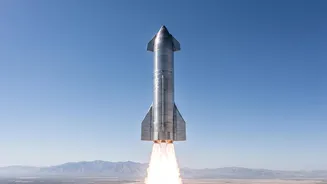
that can fly to space, deliver satellites, and then return to Earth to be used again almost immediately. That's the revolutionary promise of Starship, the colossal spacecraft developed by Elon Musk's company, SpaceX. Standing taller than the Qutub Minar when stacked on its 'Super Heavy' booster, Starship is designed to be fully and rapidly reusable. This is a game-changer. While space agencies, including our own esteemed ISRO, have mastered launching rockets, most components are expended during the mission. By creating a system that can be launched, landed, and relaunched like an airplane, SpaceX aims to drastically reduce the cost of accessing space. This could make ambitious projects, like building a base on the Moon or sending humans to Mars, economically feasible for the first time in history. Previous test flights have already achieved major milestones, including reaching orbit and successfully splashing down in the ocean.
The Planned Mission Trajectory
SpaceX's approach to developing Starship is to test, learn, and fly again quickly. The upcoming mission, known as Flight 15, is scheduled to launch from Starbase in Texas as early as November 13, 2026. The plan is incredibly ambitious: for the first time, SpaceX will attempt to catch both the Super Heavy booster and the Starship upper stage back at the launch site. However, the flight profile includes several contingency plans. If a return to the launch site is not possible for the upper stage, its default flight path is a suborbital trajectory that ends with a controlled splashdown in the Indian Ocean. This safety-first approach has been a feature of previous tests, with vehicles successfully reaching their target zones in the ocean after flying halfway around the world. It's this specific flight path that creates the possibility of a spectacular pass over the Indian region.
The Indian Ocean Connection
For a spacecraft launched from Texas to end up in the Indian Ocean, it must travel at incredibly high speeds across a vast distance. After launching eastward and achieving orbital velocity, the Starship vehicle coasts over the Atlantic Ocean and Africa before beginning its atmospheric re-entry preparations. The target splashdown zone has consistently been in the Indian Ocean, a remote area that ensures public safety. During previous flights, Starship prototypes have successfully survived the fiery re-entry process and splashed down intact, with some even remaining afloat for days. This eastward orbital path, culminating in a planned descent over the Indian Ocean, is what brings the spacecraft into a position where it could be visible from parts of India.
Could You See It From India?
The prospect of seeing Starship from the ground is thrilling,
but it depends on several factors:
the final trajectory,
the time of day,
and your location.
The vehicle will be travelling at hypersonic speeds at an extremely high altitude.
If the pass occurs during daylight,
it will almost certainly be invisible.
However,
if the timing aligns with dusk or dawn,
the chances improve dramatically.
In those conditions,
the spacecraft could be high enough to still be illuminated by the sun while the ground below is dark.
It would likely appear as a very bright,
fast_moving point of light,
possibly with a glowing plasma trail as it interacts with the upper atmosphere.
It will not look like a detailed ship to the naked eye,
but more like an exceptionally brilliant and swift meteor.
Observers in southern India and coastal areas would have the best potential vantage point,
looking out over the ocean.
Official flight details and timings are usually confirmed only a day or two before launch,
so aspiring sky_watchers should follow SpaceX's official channels for any latest updates.
A New Chapter in the Space Race
While a Starship flyby is an exciting spectacle,
its true significance lies in what it represents for the future of space exploration.
A fully reusable launch system of this scale could deploy hundreds of satellites at once,
build large space stations,
and support humanity's return to the Moon under NASA's Artemis program.
This development unfolds as India is making its own giant leaps in space.
ISRO is diligently working on the Gaganyaan mission to send Indian astronauts into orbit,
developing its own reusable launch vehicle demonstrators,
and planning ambitious robotic missions to the Moon and beyond.
The Starship program is not a competitor but a parallel development in a new global era of spaceflight,
where lowering costs and increasing access to orbit are common goals that will ultimately benefit all of humanity's aspirations among any stars.