



The Great Celestial Survey
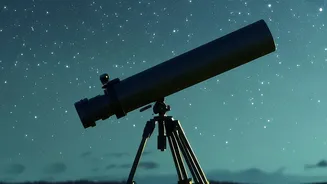
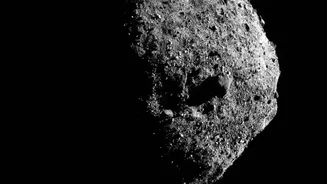
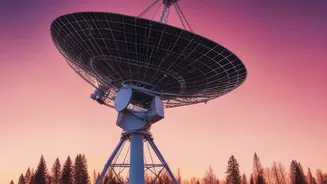
The first step in tracking an asteroid is finding it. This is the job of automated survey telescopes, which repeatedly scan large sections of the sky. Projects like the Catalina Sky Survey and Pan-STARRS take sequences of images of the same starfield
minutes apart. Sophisticated software then compares these images, searching for any 'star' that has moved. While background stars remain fixed, a nearby asteroid will betray its presence by shifting its position. This moving dot is flagged for further observation. The new Vera C. Rubin Observatory in Chile is set to revolutionise this process. With its enormous 8.4-meter mirror and the world's largest digital camera, it can image vast swathes of the sky with unprecedented sensitivity, discovering thousands of new objects in just its preliminary testing phases. Once a candidate is found, its details are sent to the Minor Planet Center, and a global network of astronomers, including amateurs, performs follow-up observations to confirm its existence and precisely calculate its orbit.
Plotting a Cosmic Path
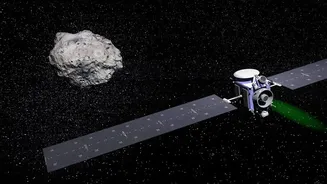
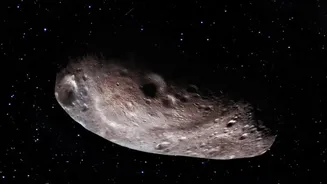
Once an asteroid is confirmed, the crucial work of plotting its trajectory begins. By taking multiple measurements of the asteroid's position over time, astronomers can map its orbit around the Sun with high precision. This allows them to predict its future path and determine if it poses any threat to Earth. None of the thousands of near-Earth objects (NEOs) recently discovered by observatories like Rubin currently pose a danger. In addition to tracking their path, scientists study changes in an asteroid's brightness. These variations, called a light curve, reveal how fast the object is spinning. Some recently discovered asteroids spin incredibly fast, with one rotating every 1.9 minutes, providing clues about their internal structure and what they're made of; they must be formed from strong material to avoid flying apart.
Catching Invisible Cosmic Rays
Unlike asteroids, cosmic rays aren't objects you can see with a traditional telescope. They are subatomic particles—protons or atomic nuclei—accelerated to nearly the speed of light by violent cosmic events far outside our solar system. These particles are extremely energetic, some carrying the kinetic energy of a tennis ball packed into a single proton. Because they are charged particles, their paths are bent by magnetic fields as they travel across the universe, making it impossible to trace them directly back to their source. Furthermore, they are incredibly rare; the most energetic ones might strike a given square kilometre of Earth only once per century.
Using the Atmosphere as a Detector
So how do you catch something you can't see? Scientists use a clever trick: they let the Earth's atmosphere do the work. When a high-energy cosmic ray or gamma ray strikes the upper atmosphere, it shatters an air molecule, creating a cascade of secondary particles called an extensive air shower. One way to detect this shower is with an Imaging Atmospheric Cherenkov Telescope (IACT). As the shower particles travel faster than the speed of light in air, they produce a faint, brief flash of blueish 'Cherenkov light'. Observatories like the Cherenkov Telescope Array (CTA) use large mirrors and ultra-fast cameras to capture this nanosecond flash, using the image to reconstruct the energy and direction of the original particle.
Listening for a Cosmic Cascade
Another ingenious method uses a different part of the air shower. The Pierre Auger Observatory in Argentina employs a hybrid detection system over a massive 3,000-square-kilometre area, roughly the size of Luxembourg. This includes 1,600 surface detectors, which are essentially large tanks of pure water. When particles from the air shower pass through the water, they generate their own Cherenkov radiation, which sensitive detectors pick up. By noting which tanks are hit and timing their signals with GPS precision, scientists can reconstruct the direction and energy of the original cosmic ray. This surface array is complemented by fluorescence detectors that watch for the faint ultraviolet light the air shower produces on moonless nights, providing another way to study these ghostly messengers from deep space.