

The Sun’s 11-Year Heartbeat
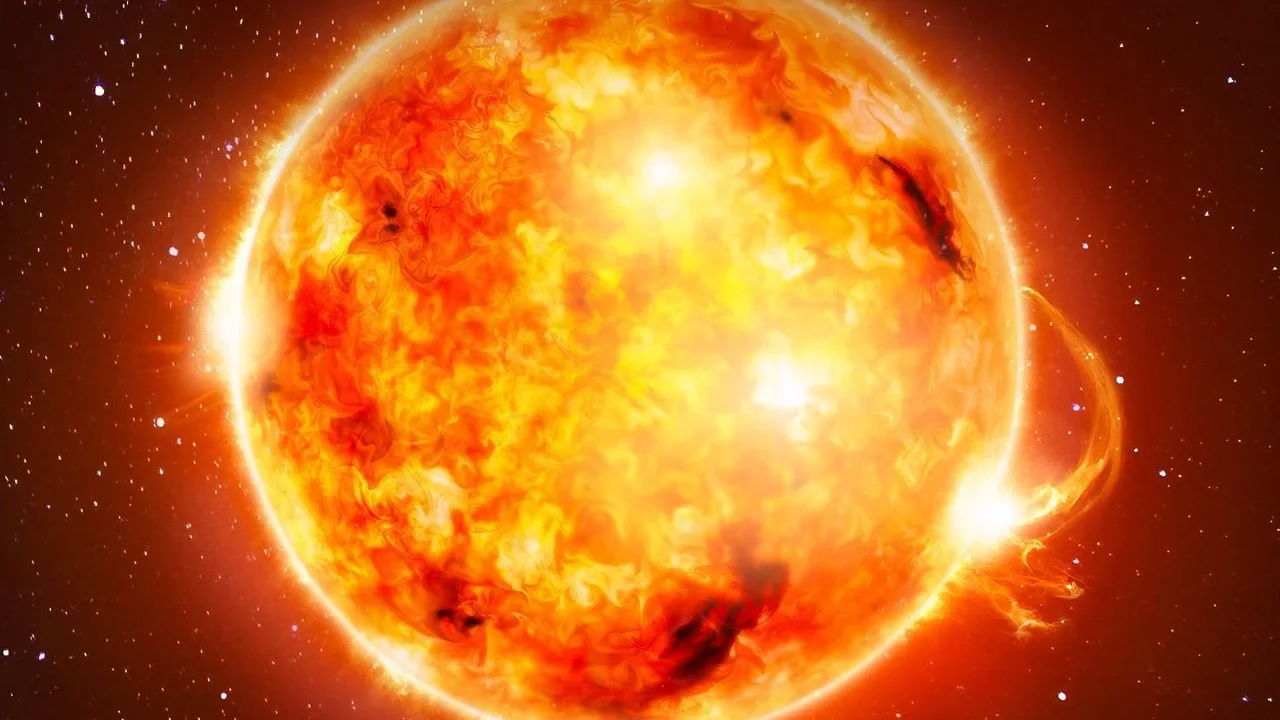
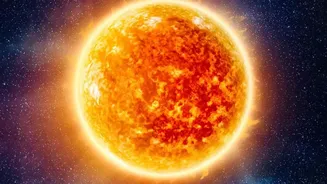
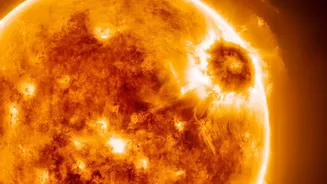
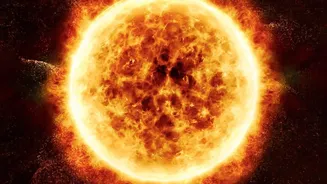
The sun is not a static ball of fire; it has a rhythmic life of its own, known as the solar cycle, which lasts approximately 11 years. This cycle swings between two extremes: solar minimum and solar maximum. During solar minimum, the sun is relatively
quiet, with few sunspots mottling its surface. But as it approaches solar maximum, its activity intensifies dramatically. The number of sunspots—dark, magnetically complex regions—increases, and the sun’s magnetic field becomes tangled and unstable. We are currently in the midst of Solar Cycle 25's peak activity period, which began earlier and has proven stronger than originally predicted, making this an exceptional time for celestial events.
Cosmic Storms on the Move
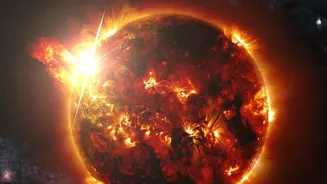
So, what are the “solar waves” that trigger these light shows? The term broadly refers to the outflow of energy and particles from the sun. This includes the constant stream of charged particles called the solar wind. However, during solar maximum, the sun is prone to more violent outbursts. Two key events are solar flares, which are intense bursts of radiation, and Coronal Mass Ejections (CMEs). CMEs are the primary drivers of strong auroras; they are colossal eruptions that hurl billions of tonnes of electrified gas and plasma into space at millions of miles per hour. Think of a solar flare as the bright flash of a cannon and the CME as the cannonball that follows.
A 93-Million-Mile Journey to Earth
When a CME is aimed at Earth, this massive cloud of solar particles travels across the solar system. The journey typically takes one to three days. As this supercharged wave approaches our planet, it collides with Earth’s magnetosphere—a protective magnetic shield generated by the molten core of our world. This shield deflects most of the solar wind, protecting life from harmful radiation. But a powerful CME can compress and interact with our magnetic field, causing a geomagnetic storm. This interaction transfers enormous energy into our planetary systems.
Earth's Magnetic Funnel
During a geomagnetic storm, the magnetosphere can't block everything. Instead, it funnels some of these high-energy solar particles down the magnetic field lines that converge at the North and South Poles. This creates two vast rings of intense energy in the upper atmosphere, known as the auroral ovals. The particles, mostly electrons and protons, are accelerated to incredible speeds as they race towards the atmosphere, primed for the final, spectacular act of their long journey.
Painting the Sky with Light
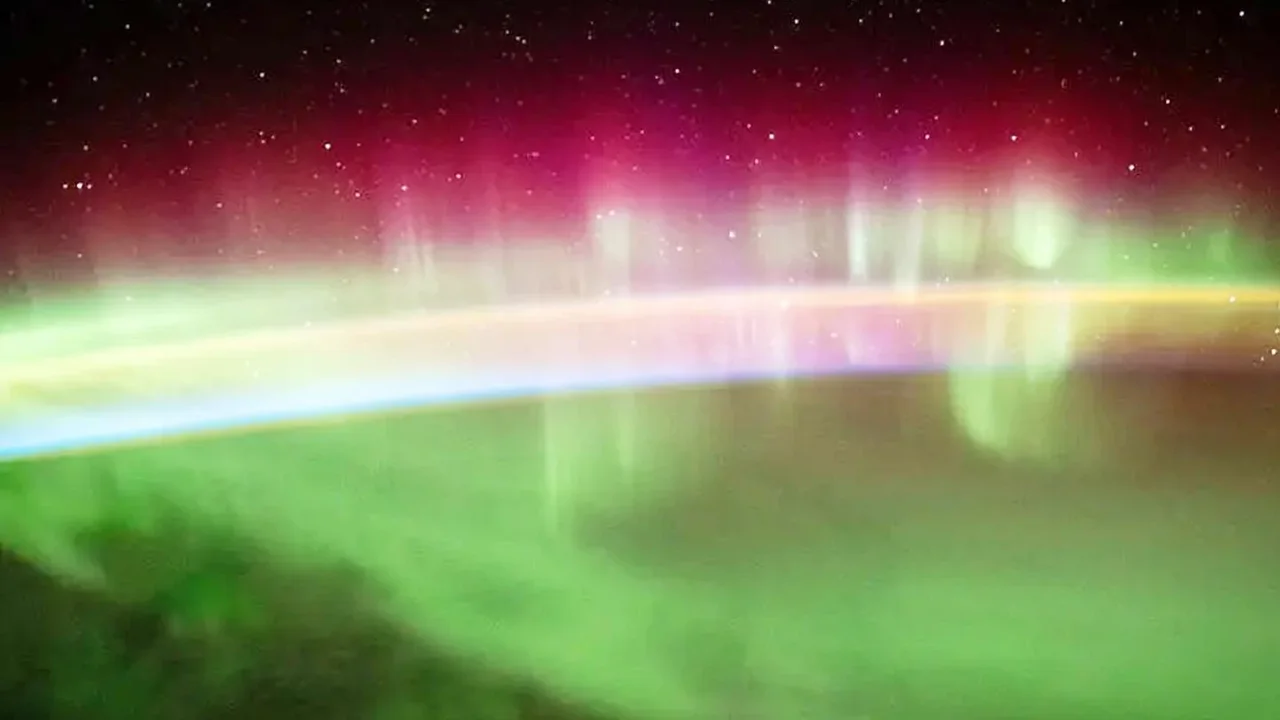
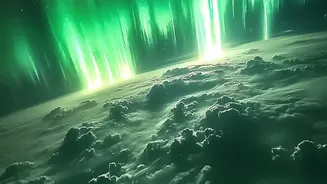
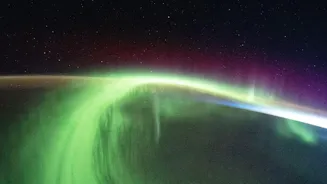
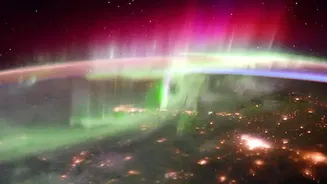
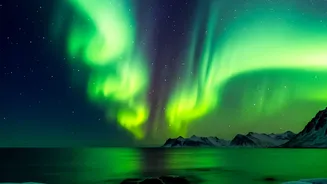
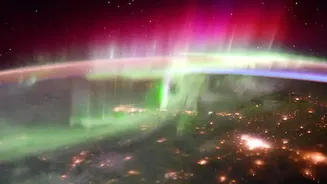
The breathtaking colors of the aurora are the direct result of these solar particles colliding with atoms and molecules in Earth's upper atmosphere. When a high-energy particle from the sun strikes an atmospheric gas molecule, it excites it, transferring energy. To return to its normal state, the gas molecule must release this extra energy in the form of a photon of light. The color of that light depends entirely on which gas was hit and at what altitude the collision occurred. The most common color, a vibrant green, is produced by excited oxygen atoms at altitudes of about 100 to 300 kilometres. Rarer, all-red auroras are caused by oxygen at even higher altitudes (above 300 km), where the atmosphere is much thinner. These are typically only seen during very intense storms. Nitrogen contributes to blue and deep purple hues at lower altitudes.
A Peak Time for Skywatchers
Because we are in a period of solar maximum, which is expected to have elevated activity through 2026, the sun is producing more frequent and powerful CMEs. This directly translates to more frequent and intense auroras. During these strong geomagnetic storms, the auroral ovals expand, allowing the lights to be seen from much lower latitudes than usual. The recent solar maximum has already produced some of the strongest storms in two decades, with auroras visible in places they are almost never seen. This heightened activity gives skywatchers a much better chance to witness one of nature's most magnificent spectacles firsthand.