


The Northern Lights are a breathtaking celestial display, but a new study reveals they can also be a harbinger of danger. Some associated magnetic disturbances can strike our power grids not in hours, but in mere minutes, shrinking reaction times.
A Warning from the Heavens
For
most of human history, the aurora borealis and aurora australis have been sources of myth and wonder. These shimmering curtains of light in the night sky are beautiful, but they are also the visible evidence of a powerful interaction between the Sun and Earth. This process, known as space weather, can do more than just paint the sky; it can have profound effects on our technology-dependent society. A new study highlights a particularly urgent aspect of this connection, finding that the ground-level magnetic disturbances that threaten electrical infrastructure can arrive with shockingly little warning. Instead of the hours-long notice grid operators sometimes get, some dangerous effects can manifest within minutes of an event occurring tens of thousands of kilometres out in space.
The Science of Substorms
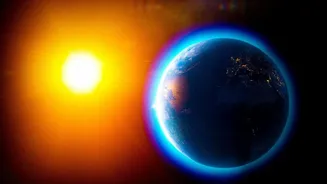
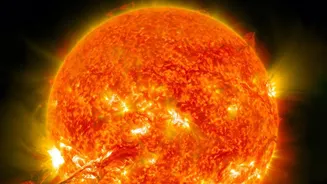
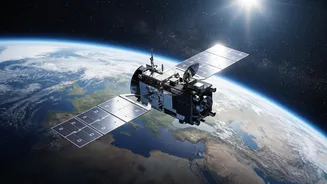
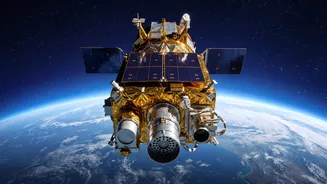
The threat originates from the Sun, which constantly sends out a stream of charged particles called the solar wind. Occasionally, a much larger eruption, a coronal mass ejection (CME), sends a massive cloud of plasma and magnetic fields hurtling toward Earth. When this material interacts with our planet's magnetic shield, the magnetosphere, it can trigger a complex chain reaction. Energy from the solar wind gets stored in Earth's magnetic tail, the part of the magnetosphere stretching away from the Sun. Eventually, this stored energy can be released explosively in an event called a geomagnetic substorm. This release sends energetic particles careening along magnetic field lines toward the poles, where they collide with atmospheric gases to create the aurora. The new research combined data from NASA spacecraft and ground-based magnetometers to trace this process, discovering that the effects of this distant energy release can reach the ground in as little as seven minutes.
Why Our Grids Are Vulnerable
The same particles that cause the aurora also drive powerful electrical currents in the upper atmosphere, known as auroral electrojets. Rapid changes in these currents induce changes in Earth's magnetic field at ground level. This, in turn, creates what are known as geomagnetically induced currents (GICs) in long conductors on the surface—like power lines and pipelines. Power grids are designed to operate on alternating current (AC). GICs are essentially a form of direct current (DC), and when they flow into the massive transformers that are the backbone of the grid, they can cause serious problems. The transformer cores can saturate, leading to overheating, damage, and the creation of harmonic distortions that can trip safety relays, taking key assets offline. This can lead to voltage instability and, in worst-case scenarios, widespread blackouts.
A Race Against a Shorter Clock
The most famous example of GICs crippling a power grid was the March 1989 storm, which collapsed the HydrostQuébec system in Canada, leaving six million people without power for nine hours. While forecasters at agencies like NOAA's Space Weather Prediction Center can often provide hours or even days of warning for an incoming CME, this new study complicates the picture. The substorm process happens after the initial interaction with the solar wind. The finding that the ground effects can follow the initial energy release in space by mere minutes presents a new challenge. It drastically shortens the window for grid operators to take preventative measures, such as rerouting power or taking sensitive equipment offline to protect it from damaging currents. The study also noted that the intensity of these ground-level disturbances can vary dramatically over short distances, with one site seeing a major magnetic swing while another just a few hundred kilometres away sees little effect.