






Why Titan is an Irresistible Target
Of all the destinations in our solar system, Titan is one of the most compelling in the search for the ingredients for life. It is the only moon with a thick atmosphere, and it has a weather system of clouds, rain, rivers, and seas—not of water, but of liquid
methane and ethane. Beneath its icy crust, scientists believe there is a vast ocean of liquid water. Most intriguingly, Titan's atmosphere is rich in complex organic molecules, the carbon-based compounds that were the building blocks of life on our own planet. In many ways, Titan is like a frozen version of early Earth, providing a unique natural laboratory to study how far prebiotic chemistry can progress.
A Revolutionary Way to Explore
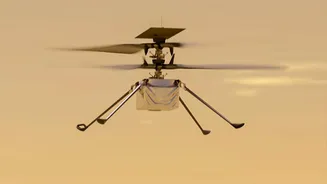
Unlike Mars rovers that are limited by terrain, Dragonfly is a rotorcraft designed to fly. Its eight rotors will take advantage of Titan's low gravity and thick atmosphere (four times denser than Earth's) to travel between dozens of promising locations. This mobility is a game-changer for planetary science. Over its planned 3.3-year mission, Dragonfly will be able to cover more than 175 kilometers, sampling diverse geological sites that would be impossible for a traditional lander to reach. The goal is to hop from the initial landing site in a vast dune field to an impact crater where liquid water and organic materials may have mixed in the past.
The Latest Progress on Earth
As of late 2026, the mission is transitioning from blueprint to reality. The spacecraft is now being physically assembled at the Johns Hopkins Applied Physics Laboratory (APL). A significant recent milestone was the installation of the electrical harness—the complex web of cables that acts as the spacecraft's nervous system, connecting its computers, instruments, and power source. This progress follows the successful completion of key design reviews and tests on components like the heat shield and lander body. While the project has faced budget and schedule adjustments, pushing its launch to July 2028, these physical assembly steps mark a crucial phase in ensuring the craft is ready for its long journey. NASA also recently announced an official name for its landing zone: 'Ahmakiq Undae,' a sprawling dune field near the scientifically valuable Selk Crater.
What This Means for Science
Every step forward in Dragonfly's construction brings scientists closer to answering fundamental questions. The mission carries a suite of instruments designed to analyze the composition of Titan's surface. Drills on its skids will collect samples and feed them into a mass spectrometer, an instrument that can identify the specific chemicals present. By studying these materials, particularly at sites like Selk Crater where an impact may have melted ice and created a temporary life-friendly soup, Dragonfly will investigate how far prebiotic chemistry has progressed. It is not designed to find existing life, but to search for chemical biosignatures—evidence that the processes necessary for life have occurred. Ultimately, the data gathered will not only reveal the secrets of Titan but could also provide profound insights into the origin of life on Earth.