

What Exactly Is a Solar Storm?
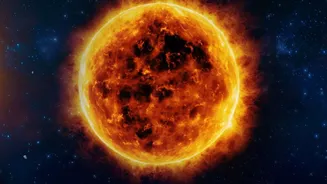
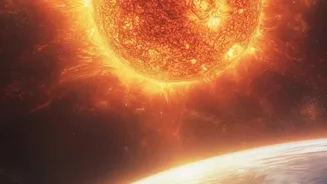
Think of a solar storm as a major disturbance on the Sun. These events are a form of "space weather" and happen when the Sun suddenly releases huge amounts of energy. This isn't like a storm on Earth with rain and wind. Instead, it involves blasts of radiation
and superheated gas, called plasma, shooting out into the solar system. The two main types of events that cause solar storms are solar flares and coronal mass ejections, or CMEs. While they sound dramatic, our planet has a natural defence system that protects us from any direct harm.
The Fiery Origin: Flares and CMEs
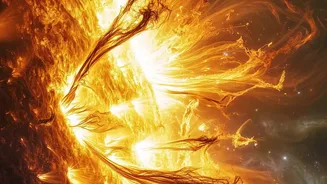
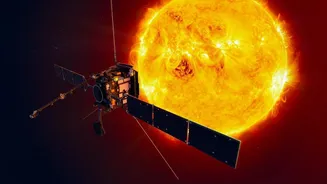
Solar storms begin with the Sun's complex magnetic fields. Imagine them as countless rubber bands twisting and stretching as the Sun rotates. When these magnetic field lines get too tangled, they can suddenly snap and reconnect, releasing a tremendous amount of energy. This can trigger a solar flare, which is an intense, bright flash of radiation. Flares are the most powerful explosions in our solar system, and their radiation travels at the speed of light, reaching Earth in about eight minutes. Sometimes, these explosions also cause a Coronal Mass Ejection (CME). A CME is a much larger event, where a giant cloud of solar plasma and magnetic fields is hurled into space. While a flare is a flash of light, a CME is like a massive cannonball of material travelling at immense speeds, though it takes much longer—anywhere from 15 hours to several days—to reach Earth.
Earth's Invisible Shield
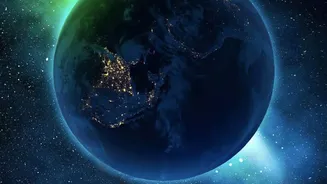
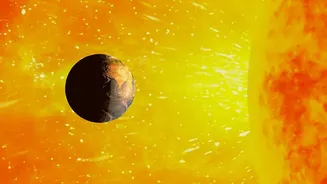
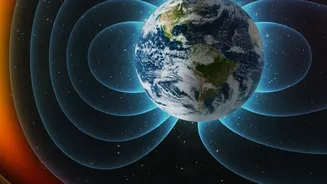
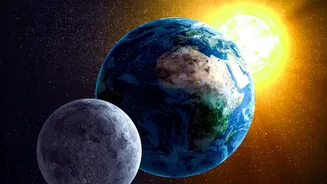
As this barrage of solar energy and particles travels the 150 million kilometres to our planet, it first encounters Earth's magnetic field, known as the magnetosphere. Generated by the molten iron in our planet's core, this magnetic field acts like an invisible protective bubble. It shields our atmosphere from being stripped away by the constant stream of particles from the Sun, called the solar wind. When a CME or a powerful gust of solar wind hits the magnetosphere, this shield deflects most of the harmful energy, guiding it around our planet. Without this crucial shield, life on Earth would not be possible.
Impact on Earth: Auroras and Tech Troubles
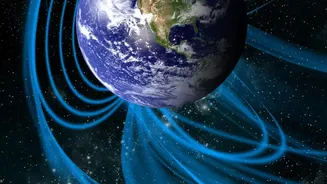
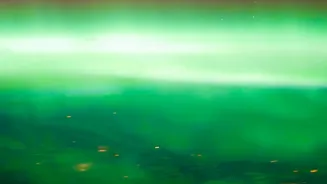
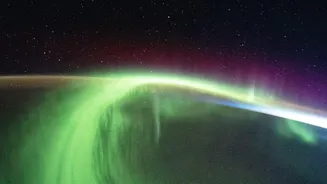
When a solar storm is particularly strong, it can disturb Earth's magnetosphere, creating what's known as a geomagnetic storm. This interaction has two major effects. The first is beautiful: the stunning auroras (the Northern and Southern Lights) appear when charged particles from the storm are funnelled down the magnetic field lines near the poles and collide with atoms in our atmosphere. The second effect is disruptive to our modern infrastructure. Geomagnetic storms can induce unwanted electrical currents in power grids, potentially damaging transformers and causing blackouts. They can also interfere with high-frequency radio communications used by aircraft and disrupt GPS signals, affecting navigation for everything from shipping to farming. Satellites are especially vulnerable as they orbit outside much of Earth's protective atmosphere; the increased radiation can damage their electronics, and atmospheric drag from a storm can even cause them to lose altitude.
Could a Major Storm Hit Us?
History shows that very large solar storms are possible. The most famous is the Carrington Event of 1859, which occurred before our modern electric world. It was so powerful that it caused telegraph systems to spark, give operators shocks, and even catch fire. Auroras were seen as far south as the Caribbean. If a storm of that magnitude were to happen today, the impact would be far more significant, potentially causing widespread and long-lasting blackouts and satellite failures. While a direct hit from a Carrington-level event is rare, scientists constantly monitor the Sun's activity. By studying solar flares and CMEs, space weather agencies can provide warnings, giving satellite operators and power grid managers time to take protective measures.