




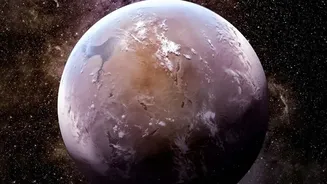
Redefining the Perfect Home
The idea of a 'superhabitable' planet challenges our Earth-centric view of the cosmos. First proposed in a 2014 paper by scientists René Heller and John Armstrong, the concept suggests that other worlds could offer conditions far more favourable for the emergence
and evolution of complex life than Earth does. They argued that simply being in a star's 'habitable zone'—the region where liquid water can exist—isn't enough. To find a truly thriving biosphere, one richer and more diverse than our own, we need to look for specific planetary and stellar characteristics that go beyond a simple Earth-like model. These worlds would likely be slightly older, larger, and warmer than Earth, with different geography. But most importantly, they would orbit a very different kind of star.
The Trouble with Our Sun
It might seem counterintuitive, but our own Sun is not the ideal star for nurturing life over cosmic timescales. The Sun is a G-type main-sequence star, or yellow dwarf, and it has a total lifespan of about 10 billion years. While that sounds like a long time, it took life on Earth nearly 4 billion years to evolve into its current complex state. Our star is already about halfway through its life and, in another billion years or so, it will become so luminous that it will boil Earth's oceans, ending any chance for life to continue evolving. This gives complex life a relatively narrow window to exist. Furthermore, G-type stars are less common than other types, making up only a small fraction of the stars in the Milky Way. This means the cosmic dice roll that led to us is rarer than it could be.
The Stellar Sweet Spot: K-Dwarf Stars
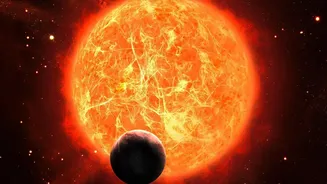
So if not a star like our Sun, what is the perfect host for a superhabitable world? Researchers have zeroed in on K-type main-sequence stars, also known as orange dwarfs. These stars have been nicknamed 'Goldilocks stars' because their properties are 'just right'. They are less massive and cooler than our Sun but warmer and less volatile than the most common stars, M-type red dwarfs. M-dwarfs, while incredibly long-lived, are notorious for violent stellar flares that can strip the atmospheres from nearby planets, making life a difficult proposition. K-dwarfs, on the other hand, are remarkably stable. They emit less harmful high-energy radiation than G-type stars like our Sun but are powerful enough that their habitable zones are wide and distant enough to prevent a planet from becoming 'tidally locked', where one side perpetually faces the star.
Time Is the Ultimate Ingredient
The single greatest advantage of a K-dwarf star is its extraordinary lifespan. While our Sun will burn for about 10 billion years, a K-dwarf can remain stable for anywhere between 15 billion and 45 billion years—several times the current age of the universe. This immense timeframe is the ultimate resource for life. It allows billions of extra years for life to not only emerge but to evolve, diversify, and develop staggering complexity. It also provides a biosphere with more time to recover from planetary-scale disasters, like asteroid impacts or mass extinctions. For scientists searching for intelligent life, this extended timeline is particularly tantalizing, as it took humanity a significant portion of Earth's history to appear. With a K-dwarf, a planet's biological story could be much, much longer than ours.