





The Junkyard Above Our Heads
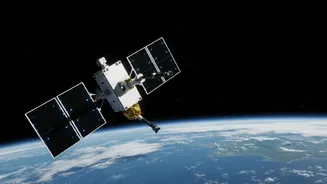
Low Earth Orbit (LEO) is an orbital superhighway essential for modern life. It hosts thousands of satellites that provide everything from GPS navigation and weather forecasting to global communications and banking services. But for over 60 years, this
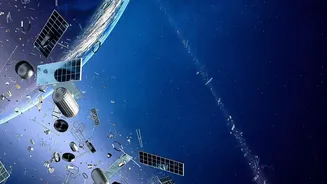
vital region has also become a dumping ground. Every rocket launch and satellite deployment has the potential to leave behind debris. The result is a cloud of more than 9,300 tonnes of space junk, including over 34,000 objects larger than 10cm and an estimated 1.2 million pieces between 1cm and 10cm. These objects aren't just floating; they're moving at speeds up to 28,000 km/h. At that velocity, even a small paint fleck can cause significant damage to an operational satellite or the International Space Station.
A Cascade of Collisions
The primary concern for space agencies and commercial satellite operators is a scenario known as the Kessler Syndrome, first proposed in 1978. It describes a tipping point where the density of debris in orbit becomes so high that collisions create a chain reaction. One impact generates more debris, which in turn increases the probability of further impacts, leading to an exponential growth of space junk. A single collision, like the one in 2009 between an Iridium communications satellite and a defunct Russian military satellite, can create thousands of new debris fragments. Experts warn that we are approaching this tipping point, which could render certain orbits unusable for generations, jeopardising a burgeoning space economy and future exploration missions.
Enter the Magnetic Lasso
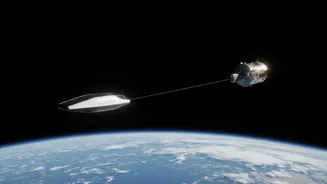
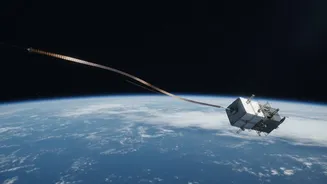
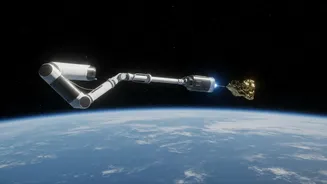
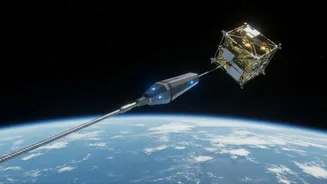
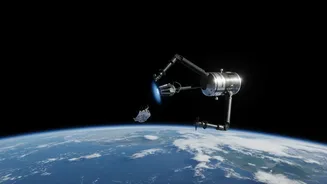
To combat this growing threat, scientists and engineers are developing innovative solutions for Active Debris Removal (ADR). Among the most promising are magnetic capture systems and electrodynamic tethers. One method involves a 'chaser' spacecraft equipped with powerful electromagnets. This craft can approach a dead, tumbling satellite and use magnetic forces to gently grab it without direct physical contact, reducing the risk of creating more debris. Once captured, the chaser can either drag the junk into a lower orbit where it will burn up in Earth's atmosphere or move it to a safe 'graveyard' orbit. Another concept is the electrodynamic tether, a long, conductive wire deployed from a satellite. As the tether moves through Earth's magnetic field, it generates a current. This interaction creates a drag force that can slow the debris, causing its orbit to decay much faster than it would naturally. Several companies and agencies, including Japan's JAXA and the European Space Agency (ESA), have been testing these technologies.
The Pioneers of Clean Space
A global ecosystem of startups and established aerospace giants is racing to make space cleanup a commercial reality. Companies like Japan's Astroscale and Switzerland's ClearSpace are leading the way. Astroscale has already demonstrated its ability to capture a test satellite using a magnetic docking plate. ClearSpace was commissioned by ESA for a mission to remove a large piece of debris, using a four-armed capture system. Other players like Altius Space Machines are developing magnetic and robotic docking technologies, while startups like Obruta and Portal Space Systems are working on net-based and repeatable removal services. These efforts are supported by government initiatives like the US ORBITS Act, which directs NASA to fund and collaborate with commercial partners on debris removal technologies, signaling a serious commitment to orbital sustainability.
The Long Road to a Cleaner Orbit
While magnetic tethers and other capture methods are promising, significant challenges remain. Capturing an uncontrolled, tumbling object weighing several tonnes is a complex robotic and navigational feat. Furthermore, the sheer scale of the problem is daunting. With millions of pieces of debris, cleanup efforts must be both efficient and cost-effective to make a meaningful impact. The current focus is on removing the largest and most dangerous objects—defunct satellites and large rocket bodies—which pose the highest risk of generating massive debris clouds if they collide. Successfully demonstrating these technologies is the first step. The next will be deploying them at a scale that can begin to reverse the decades-long pollution of our orbital environment, ensuring that Low Earth Orbit remains a safe and valuable resource for the future.