





What 'Day' Are We Talking About?
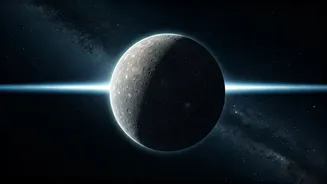
Before we dive into Mercury’s peculiar schedule, it’s important to understand that planets have two kinds of 'days'. There's the sidereal day, which is the time it takes for a planet to complete one full rotation on its axis relative to the distant stars.
This is what we mean when we say a day on Mercury is about 59 Earth days long (to be precise, it’s 58.6 days). Then there’s the solar day, which is the time it takes for the Sun to appear in the same position in the sky — for example, from one sunrise to the next. On Earth, these two are very close, just a few minutes apart. On Mercury, however, the difference is astronomical, and that’s where things get truly weird.
Mercury's Unique Cosmic Dance
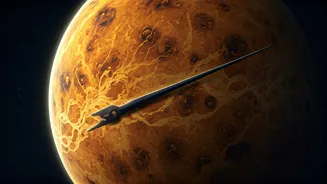
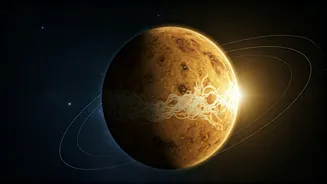
The reason for Mercury's long sidereal day is something scientists call a '3:2 spin-orbit resonance'. This sounds complex, but the idea is simple. For every two trips Mercury makes around the Sun (its 'year'), it spins on its axis exactly three times. This gravitational lock is a result of the Sun’s immense pull on the small, nearby planet. Think of it like a dancer who completes three pirouettes for every two laps she makes around the stage. This slow, deliberate spin is fundamentally different from Earth’s brisk 24-hour rotation, which gives us our familiar day-night cycle. Mercury is in no such hurry.
A 'Day' Longer Than a Year
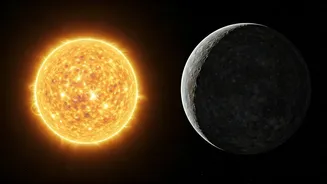
Here's where it gets even more mind-bending. While it takes Mercury 59 Earth days to spin once, its solar day—the time from sunrise to sunrise—is about 176 Earth days long! How is this possible? It’s because Mercury is also hurtling around the Sun at high speed, completing an orbit in just 88 Earth days. Because its rotation is so slow and its orbit is so fast, it takes a very long time for the Sun to return to the same spot in Mercury’s sky. This means a single solar day on Mercury is twice as long as its entire year. You could celebrate two birthdays in the time it takes to get from one noon to the next.
Life in the Land of Extremes
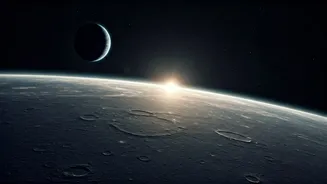
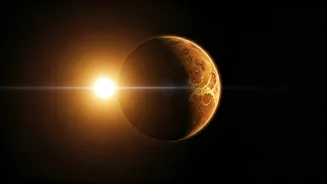
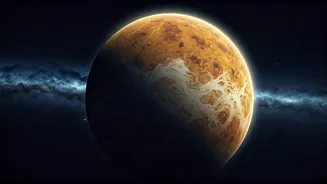
This incredibly long solar day has dramatic consequences for the planet’s surface. The side facing the Sun gets baked for months on end, with temperatures soaring to a scorching 430 degrees Celsius—hot enough to melt lead. There is no atmosphere to distribute this heat, so it’s just relentless solar radiation. Meanwhile, on the side experiencing the long, dark night, temperatures plummet to a bone-chilling minus 180 degrees Celsius. This makes Mercury a planet of unimaginable extremes, with the greatest temperature fluctuations in the solar system. It’s a world of fire and ice, all in the space of a single, drawn-out day.
A Sun That Moves Backwards
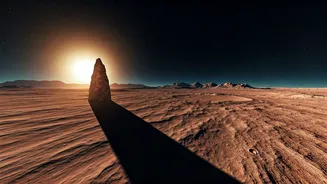
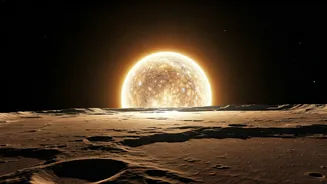
The strange interplay of Mercury’s spin and orbit creates one last bizarre spectacle. At certain points on its surface, an observer would see the Sun rise, halt in the sky, move backwards for a short period, and then resume its forward journey. This phenomenon, known as 'retrograde motion', happens because at a specific point in its elliptical orbit, Mercury is moving around the Sun faster than it is rotating. For a brief moment, its orbital speed overtakes its spin, making the Sun appear to reverse course. It’s a powerful reminder that the celestial mechanics we take for granted on Earth are not universal rules.