



The Ultimate Insurance Policy
In human spaceflight, success is not just about a perfect launch; it is fundamentally about bringing the crew back safely. The Crew Escape System (CES) is ISRO's ultimate insurance policy for its Vyomanauts. It is an emergency abort system designed to
do one thing: rapidly pull the crew module, with the astronauts inside, away from a failing rocket during the most dangerous phases of launch. Think of it as a highly advanced ejection seat, but instead of ejecting a single pilot, it ejects the entire space capsule. This system is conceived to ensure crew safety in case of any catastrophic emergency within the atmospheric flight regime, from the launch pad to higher altitudes. Its flawless function is non-negotiable, as there are no second chances when a launch goes wrong.
How a Fiery Escape Works
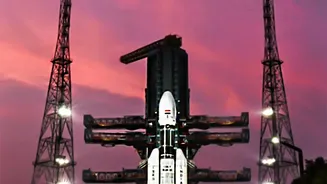
The Gaganyaan's CES is a 'puller' type system, similar to those used in the Apollo and Soyuz missions. It is a tower-like structure fixed to the top of the crew module, containing a series of powerful, fast-acting solid rocket motors. An intelligent network of sensors, called the Integrated Vehicle Health Management System (IVHM), constantly monitors the rocket's vital parameters. If this system detects a critical anomaly—like a loss of thrust or a structural failure—it automatically triggers the abort sequence in milliseconds. The escape motors fire, generating immense thrust to yank the crew module clear of the malfunctioning launch vehicle with powerful acceleration. Once at a safe distance, the escape tower jettisons, and a series of parachutes deploy to slow the crew module for a safe splashdown in the sea.
Testing for a Worst-Case Scenario
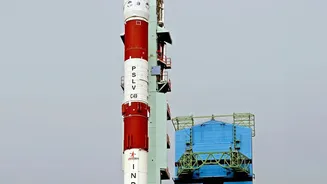
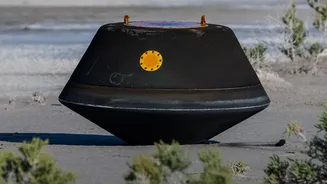
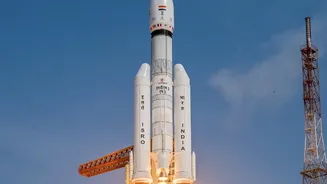
The reason testing the CES is so crucial is that it must work perfectly under the most chaotic and violent conditions imaginable. ISRO has designed a series of demanding tests to validate every aspect of the system. A 'Pad Abort Test' (PAT) was successfully conducted in 2018, demonstrating the system's ability to pull the crew module to safety from the launch pad itself. More recently, the Test Vehicle Abort Mission-1 (TV-D1) simulated an in-flight emergency. In this test, a specially designed test rocket flew to an altitude of about 17 km, reaching transonic speeds (around Mach 1.2), a point of maximum aerodynamic stress. The abort was then intentionally triggered, and the CES successfully separated the crew module, which was later recovered from the Bay of Bengal by the Indian Navy. These tests are designed to prove the system functions reliably during the most vulnerable moments of ascent.
No Room for Error
The entire abort sequence, from detection of a problem to the crew module being pulled away, happens in seconds. There is no manual override; the system must be completely autonomous and reliable. This requires hundreds of components to work in perfect harmony. Failure is not an option when lives are at stake. As ISRO Chairman S. Somanath has emphasized, ensuring the crew is not lost due to a rocket failure is at the core of human spaceflight. The exhaustive testing process is designed to find and fix any potential flaws before astronauts are ever on board. This meticulous approach builds confidence not just within ISRO, but for the entire nation, demonstrating a commitment to global safety standards. Every successful test provides invaluable data, validating the design and mission sequences.
The Foundation of a Dream
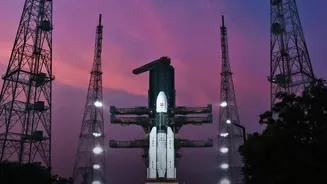
Sending Indians to space is a landmark ambition, placing the country in an elite group with the United States, Russia, and China. But this dream rests entirely on the bedrock of safety. While the powerful LVM3 rocket, orbital manoeuvres, and the return journey capture the imagination, the silent guardian atop the rocket—the Crew Escape System—is the true enabler of the mission. Its proven reliability is what allows astronauts to strap into their seats with confidence. The successful tests of the CES are not just technical achievements; they are a declaration that ISRO prioritizes the lives of its crew above all else. This makes its qualification the single most important step on the path to making the Gaganyaan mission a reality.