




A Tale of Two Stages
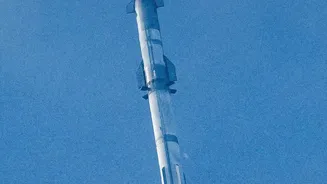
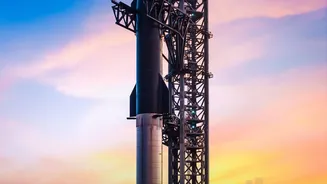
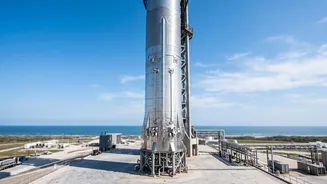
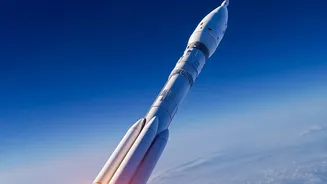
The mission on November 13-14, 2026, was SpaceX's most ambitious test flight yet. The goal was a 'double catch': to launch the two-stage Starship rocket, have both the Super Heavy booster and the Starship upper stage return to the launch site in Texas,
and catch both mid-air with the giant mechanical arms of the launch tower. After lifting off, the upper stage, known as Ship 42, successfully separated and proceeded to orbit, where it completed its own mission of deploying 26 next-generation Starlink satellites. However, the first stage, Booster 22, ran into trouble on its way back down.
What Happened to the Booster?
Minutes after a successful liftoff, the Super Heavy booster began its return journey. The plan was for it to fly back to the launch pad and be caught by the tower's arms, a maneuver SpaceX has performed with previous boosters. This time, however, the booster’s automated systems detected a problem. According to SpaceX officials, early signs pointed to a 'low fuel mass alarm' that caused the boost-back burn to end prematurely. The onboard guidance system then correctly followed its safety protocols, aborting the tower catch and diverting the booster for a splashdown in the Gulf of Mexico, where it was lost. While the loss of 33 advanced Raptor engines is a setback, the autonomous safety abort worked as designed, protecting the ground infrastructure.
The Billion-Dollar Catch
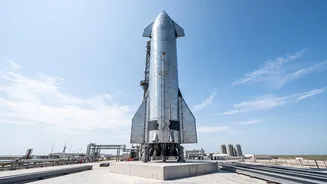
While the booster drama unfolded, the Starship spacecraft spent nearly 22 hours in orbit, completing 14 laps around the Earth. It then began its fiery descent. After surviving the intense heat of atmospheric reentry, the 171-foot-tall vehicle performed a series of complex aerodynamic maneuvers to slow down and align itself with the launch site. In the final moments, it ignited its engines, flipped to a vertical orientation, and hovered over the launch tower. The tower's huge mechanical arms, nicknamed 'Chopsticks' or 'Mechazilla', closed around the ship, securing it in a clean catch. It was the first time in history an orbital spacecraft had been caught this way, a moment one SpaceX commentator called 'the Holy Grail of spaceflight'.
Why Reusability Is the Holy Grail
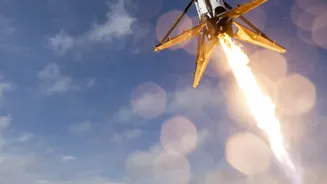
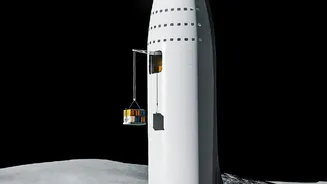
The focus on catching rockets isn't just for show; it's central to SpaceX's entire business model. The ultimate goal is to make Starship a fully and rapidly reusable transportation system, much like an airplane. Landing rockets at sea, as the company does with its Falcon 9 boosters, requires ships, recovery crews, and extensive refurbishment due to saltwater corrosion. Catching both stages directly at the launch tower eliminates most of those logistical hurdles. In theory, a caught rocket could be refueled and launched again in a matter of hours or days, not weeks or months. This dramatic increase in launch frequency and reduction in cost is what could enable ambitious projects like building a base on the Moon or a city on Mars.
A Milestone That Changes Everything
In an iterative development program like Starship's, not every test objective needs to be met for a flight to be a monumental success. While the failure to recover the booster stings, the successful catch of the Starship upper stage is by far the more significant achievement. The ship's return from orbital velocity is a much harder engineering problem to solve than the booster's return from a lower altitude and speed. By proving the catch is possible, SpaceX has validated a core component of its architecture for making humanity a multi-planetary species. The company will now analyze the recovered Ship 42 to assess its condition and determine how quickly it could be prepared for its next flight. The loss of the booster will be investigated, but it does not change the fact that the hardest part of the mission was a resounding success.