

The Sun's Final Act
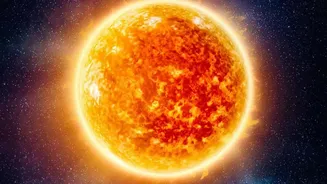
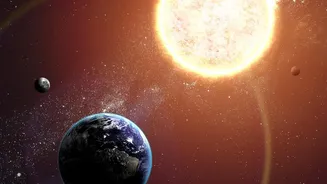
Like all stars of its kind, our Sun has a finite lifespan. For roughly 4.6 billion years, it has been in its stable 'main sequence' phase, fusing hydrogen into helium in its core. But in about another five billion years, that hydrogen fuel will run low.
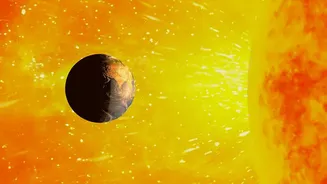
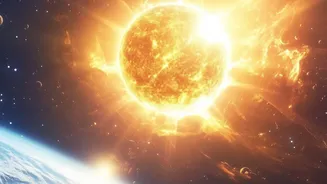
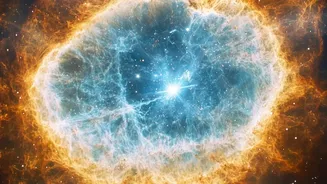
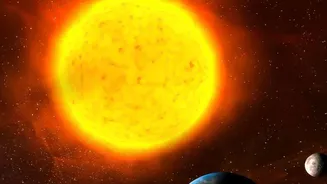
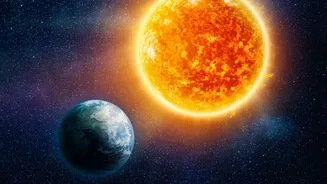
The Sun will then begin its death throes, first swelling into a red giant. In this phase, its outer layers will expand dramatically, likely consuming Mercury, Venus, and possibly even Earth. After this destructive expansion, the Sun will shed its outer layers, leaving behind a dense, hot stellar core known as a white dwarf—a remnant roughly the size of Earth but containing about half the Sun's original mass.
A Violent, Unsteady End
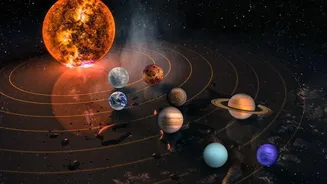
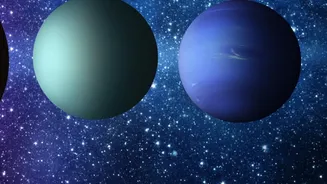
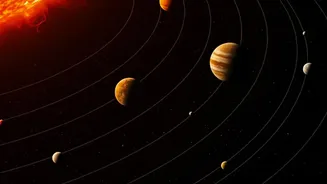
For a long time, astronomers believed the Sun would lose mass in a slow, steady stream. This would cause the surviving outer planets—Jupiter, Saturn, Uranus, and Neptune—to gently drift into wider, but stable, orbits. Previous models suggested this expanded solar system could remain intact for as long as a quintillion years. However, a recent study published in The Astrophysical Journal Letters challenges this peaceful picture. New simulations run by a team of astrophysicists suggest the Sun's mass loss won't be smooth. Instead, it will be a turbulent process, with the star ejecting its mass in uneven, energetic bursts. These gravitational 'kicks' will shake up the entire system.
Chaos Among the Giants
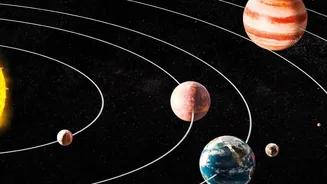
This new model of a chaotic stellar death dramatically shortens the lifespan of our solar system's architecture. The research indicates that the gravitational instability previously thought to be caused by passing stars will actually be triggered by the Sun itself. According to the new simulations, there is a 90% chance the outer planetary system will break down within three billion years of the Sun becoming a white dwarf—a billion times shorter than prior estimates. In many scenarios, the disruption begins even earlier, during the red giant phase. The potential outcomes are wild, with some simulations showing Uranus and Neptune being ejected from the solar system entirely, or even swapping orbits.
The New Era of a White Dwarf
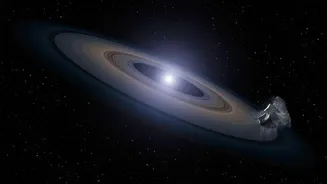
Even after the Sun settles into its white dwarf phase, the solar system will continue to be a dynamic place. The weakened gravity of the much lighter star, combined with the reshuffled orbits of the giant planets, will stir up the remaining debris. Asteroids and comets from the outer reaches, such as the Kuiper Belt, could be knocked from their stable paths. Some will be flung into interstellar space, while others will be sent hurtling toward the white dwarf. Astronomers observe this very phenomenon in other star systems, where 'polluted' white dwarfs show atmospheres contaminated with heavy elements from recently devoured rocky bodies. This tells us that even in death, a star continues to shape and dismantle its planetary system.
A Temporary Thaw for Icy Worlds
While the red giant phase will be catastrophic for the inner planets, it will bring a brief, dramatic change to the outer solar system. As the Sun swells and its brightness increases hundreds of times over, the habitable zone—the region where liquid water can exist—will shift outward. For a few hundred million years, frigid moons around Jupiter and Saturn, such as Europa and Titan, could be warmed enough to host liquid oceans on their surfaces. It would be a fleeting spring for these icy worlds before the Sun collapses into a dim white dwarf, plunging the entire system into a deep and permanent cold. This temporary warming highlights the profound but temporary transformation the outer solar system will undergo.