



The Universe's Speed Limit
Light travels incredibly fast—at about 3,00,000 kilometres per second. At this speed, it could circle the Earth seven and a half times in a single second. It’s the ultimate speed limit in the universe; nothing can travel faster. But in the vast emptiness
of space, even this mind-boggling speed takes time. When you see a flash of lightning, you hear the thunder seconds later because light travels much faster than sound. The cosmos works on a similar principle, but on a scale that is almost impossible to comprehend. The distances are so immense that even light, the fastest thing there is, becomes a cosmic messenger carrying old news.
More Than Just Distance
This is where the concept of a 'light-year' comes in. It sounds like a measure of time, but it’s actually a measure of distance. A light-year is the distance light travels in one year—a staggering 9.5 trillion kilometres. But this unit cleverly contains time within it. The closest star to our Sun, Proxima Centauri, is about 4.2 light-years away. This means the light we see from it tonight actually left the star 4.2 years ago. If Proxima Centauri were to suddenly disappear, we wouldn't know for another 4.2 years. Even our own Sun is not 'live'. Its light takes about 8 minutes and 20 seconds to reach us. When you look at the Sun (safely, of course!), you are seeing it as it was over eight minutes in the past.
Your Sky Is a Time Machine
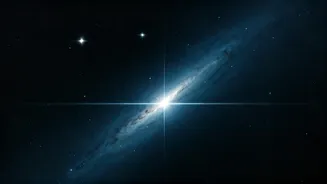
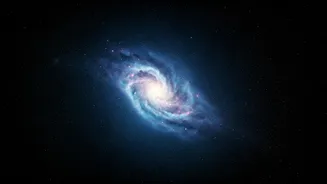
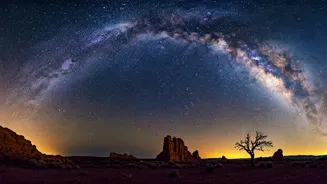
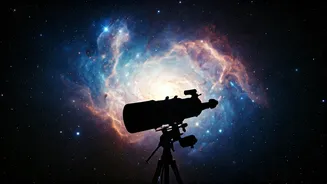
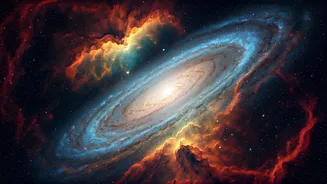
This delay is known as 'lookback time', and it turns every telescope into a time machine. The farther away we look, the further back in time we see. Consider the Andromeda Galaxy, the closest major galaxy to our own Milky Way. It is a faint smudge of light visible to the naked eye from a dark location. That smudge is 2.5 million light-years away. The photons of light hitting your retina tonight began their journey from Andromeda when early human ancestors, like Homo habilis, were first roaming the plains of Africa. You are not seeing the Andromeda Galaxy as it is today; you are seeing it as it was 2.5 million years ago.
Gazing at Cosmic Dawn
Astronomers use this principle to study the evolution of the universe. Powerful observatories like the Hubble Space Telescope and the newer James Webb Space Telescope (JWST) are designed specifically to be powerful time machines. By staring at a tiny, seemingly empty patch of sky for days on end, they can collect the faint, ancient light from the most distant galaxies. Some of the objects JWST has spotted are over 13.4 billion light-years away. Considering the universe is about 13.8 billion years old, we are seeing these galaxies as they were just a few hundred million years after the Big Bang. We are witnessing the cosmic dawn, the moment the first stars and galaxies began to light up the universe. Instruments in India, like the Giant Metrewave Radio Telescope (GMRT) near Pune, also play a crucial role in this global quest, studying radio waves from distant cosmic events to piece together this history.
Why This Matters
This isn't just a fascinating piece of trivia; it’s the foundation of modern cosmology. By observing galaxies at different distances—and therefore, at different points in their life cycles—astronomers can build a cohesive story of how the universe grew and changed over billions of years. We can see how galaxies collided and merged, how stars formed and died, and how the chemical elements necessary for life were created and distributed across space. Studying ancient light allows us to trace our own cosmic lineage, answering the fundamental questions of where everything, including us, came from. It transforms stargazing from a passive activity into an active journey through time.