


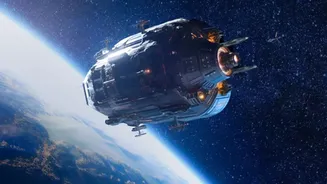
Sailing on Sunshine
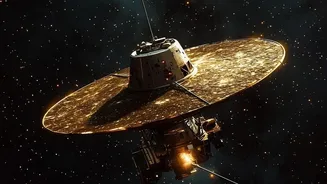
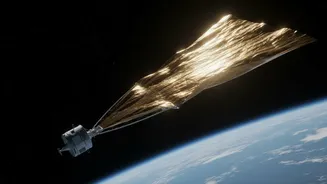
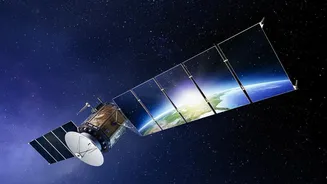
So, what exactly is a solar sail? Imagine a giant, ultra-thin mirror, thinner than a human hair, attached to a spacecraft. Instead of wind, this sail catches sunlight. Light is made of particles called photons which, despite having no mass, carry momentum.
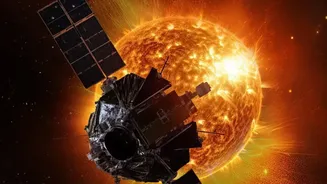
When countless photons from the sun bounce off the sail's reflective surface, they transfer their momentum, giving the spacecraft a tiny but continuous push. Unlike a conventional rocket that burns through its fuel in a powerful but short burst, a solar sail accelerates constantly. In the frictionless vacuum of space, this gentle, unending push allows the spacecraft to build up tremendous speeds over time, far beyond what chemical rockets can achieve.
A Major Deployment Milestone
The latest headline-making news comes from successful ground tests of increasingly large and complex solar sail systems. One recent key milestone involved the full deployment of a single quadrant of a massive sail that will eventually measure over 17,000 square feet. These tests, conducted by NASA and its commercial partners like Redwire, are critical for proving that these huge, delicate structures can be packed into a small volume for launch and then reliably unfurl in space. Another mission, the Advanced Composite Solar Sail System (ACS3), has been testing new lightweight carbon fibre booms in orbit, which are essential for supporting sails that could be 20 times larger than previous versions. Successfully deploying these large sails and their supporting booms is one of the biggest engineering hurdles, and these tests mark a huge step in validating the technology for future missions.
The Problem with Conventional Rockets
For journeys within our solar system and beyond, traditional rockets face a fundamental limitation: fuel. To go faster or farther, a rocket needs more propellant, which makes the rocket heavier, which in turn requires even more fuel just to lift off. This vicious cycle makes missions to the outer planets long, multi-year endeavours. The Voyager 1 spacecraft, for example, has been travelling for decades and it would still take it tens of thousands of years to reach the nearest star system. Solar sails offer a game-changing alternative. By eliminating the need for heavy onboard propellant, spacecraft can be made significantly lighter. This 'free' and unlimited source of propulsion means that, in the long-distance race against a rocket, the slow-and-steady solar sail will eventually overtake it, achieving speeds currently impossible for conventional craft.
Unlocking Interstellar Travel
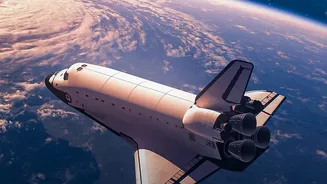
The speed potential is astounding. Projections suggest a solar sail-powered craft could eventually reach speeds of over 3,00,000 km/h, which is about ten times faster than a space shuttle's orbital speed. At that velocity, a trip to the outer planets could take months instead of years. More excitingly, it brings the dream of interstellar travel into the realm of possibility. Missions that would take a conventional probe 20 years could potentially be completed in a fraction of that time. Some concepts even envision using powerful lasers based in space to give the sails an extra push as they depart our solar system, accelerating them to a fraction of the speed of light. This could allow us to send probes to nearby stars within a human lifetime.
Challenges on the Horizon
Despite the promising tests, there are still significant challenges to overcome. The materials used for the sails must be incredibly lightweight, durable, and reflective. Controlling and navigating a craft with such a large, delicate structure is also a complex problem that engineers are actively working to solve. Early orbital tests, like with the ACS3 mission, have sometimes encountered minor issues, such as a slight bend in a deployment boom, providing valuable lessons for future designs. The initial acceleration is also very slow, making solar sails less suitable for missions requiring rapid manoeuvres. However, each test and every new material innovation brings us closer to overcoming these hurdles.