


The Cosmic Yardstick Problem
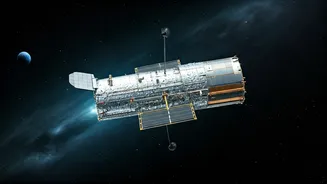
One of Hubble's primary missions was to determine the expansion rate of the universe, a value known as the Hubble Constant. For years, its precise measurements of distant stars and galaxies helped astronomers calculate the universe's age, pinning it down
to about 13.8 billion years. But as Hubble's observations have become more refined, they have revealed a frustrating and fascinating problem now known as the 'Hubble Tension.' Measurements of the 'local' universe, based on Hubble's data, suggest a faster expansion rate than measurements of the 'early' universe, derived from the cosmic microwave background. This isn't just a rounding error; the discrepancy is significant enough to suggest that our standard model of cosmology might be missing something fundamental. Is there a new type of particle or force at play? Hubble didn’t just give us a number; its enduring precision has uncovered a crack in our understanding of the cosmos, making old questions new again.
A Living Movie of the Nebulae
Hubble’s iconic images, like the 'Pillars of Creation' in the Eagle Nebula, have defined our popular conception of the cosmos. But Hubble's longevity has transformed these static portraits into frames of a cosmic movie. By revisiting targets like the Pillars and the Crab Nebula over decades, astronomers can now see these celestial clouds breathe and evolve. In 2015, when Hubble took a new, higher-resolution image of the Pillars, a comparison with the 1995 original revealed a jet of material from a newborn star had stretched 96 billion kilometres in the intervening years. Similarly, new observations of the Crab Nebula, the remnant of a supernova seen on Earth in 1054 A.D., show its filaments expanding at over 5 million kilometres per hour. We tend to think of the sky as unchanging, but Hubble’s long-term observations prove that the universe is a dynamic and active place on a human timescale, making history a living process.
Rewriting the Dawn of Time
How did the universe emerge from its primordial dark ages? This is one of the biggest questions in astronomy, and Hubble continues to provide surprising answers. Initially, its Deep Field images shocked scientists by showing that galaxies formed much earlier than previously believed. More recently, in June 2026, astronomers announced that Hubble had detected ultraviolet light from a tiny, distant galaxy called MXDFz4.4, which existed just 1.4 billion years after the Big Bang. It was thought the 'fog' of neutral hydrogen gas in the early universe would make such an observation impossible. This discovery provides crucial evidence for how the first stars and galaxies burned away that fog in a process called reionization, transforming the cosmos from opaque to transparent. Every new observation pushes the frontier of known history further back, with an old telescope leading the way.
A New Partnership in the Sky
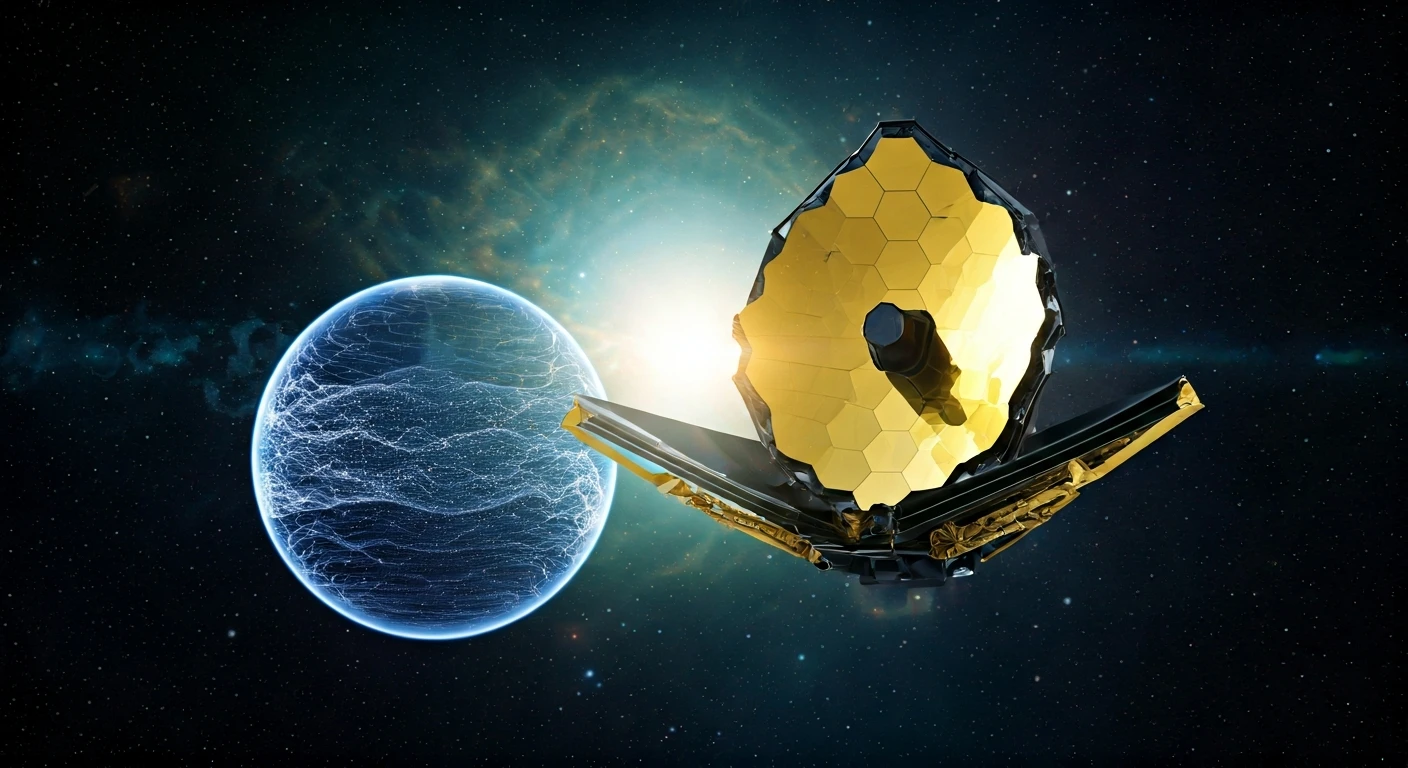
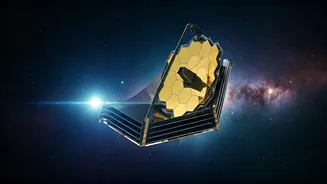
The arrival of the James Webb Space Telescope (JWST) in 2021 didn't signal Hubble's retirement; it marked the beginning of a powerful new partnership. While Webb is designed to see the universe in infrared light, peering through dust clouds that obscure Hubble’s view, Hubble’s ability to see in visible and ultraviolet light is unique and complementary. Together, they provide a more complete picture of the universe. When Webb confirmed Hubble's measurements for the Hubble Tension were not due to observational errors, it deepened the mystery rather than solving it, proving the value of having two independent sets of eyes. They have collaborated on stunning, comprehensive images of objects like the Pillars of Creation and galaxy cluster MACS0416, combining Webb's infrared depth with Hubble's visible light detail. This tag-team approach means Hubble isn't just making history; it's a vital part of astronomy's future.