
The Cosmic Laboratory Next Door
The science of understanding a planet by comparing it to others is called comparative planetology. It’s a powerful tool because nature has provided us with planetary experiments on a scale we could never replicate. All the planets in our solar system
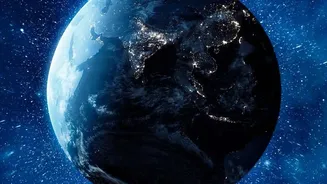
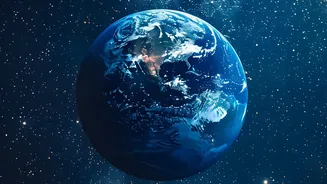
were formed from the same basic ingredients, yet they ended up incredibly different. Earth is a vibrant world of oceans and life, while Venus is a toxic inferno and Mars is a frigid, dusty desert. By studying why our neighbours took such different paths, we gain a much deeper understanding of the delicate balance that makes Earth habitable and the forces that could disrupt it.
Venus: A Chilling Climate Warning
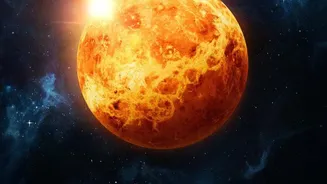
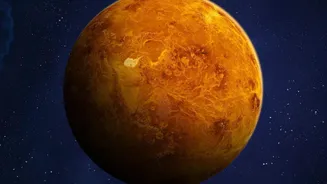
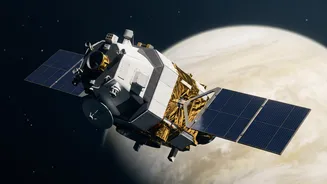
Often called Earth's "evil twin" due to its similar size, Venus serves as a dramatic cautionary tale. Its atmosphere is over 96% carbon dioxide, creating a runaway greenhouse effect that pushes surface temperatures to a staggering 475°C—hot enough to melt lead. Scientists believe Venus may have once had oceans, much like Earth. However, as the Sun's heat intensified over billions of years, these oceans evaporated, releasing massive amounts of water vapour—a powerful greenhouse gas—into the atmosphere. This created a feedback loop, trapping more and more heat until the planet became the scorched world it is today. Studying this process on Venus helps climatologists refine their models for Earth, showing in stark reality how an unchecked rise in greenhouse gases can fundamentally alter a planet.
Mars: The Ghost of a Watery World
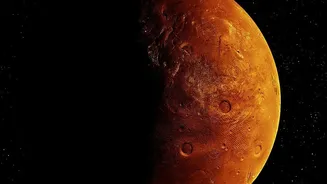
If Venus shows the dangers of too much atmosphere, Mars shows the peril of losing it. Evidence strongly suggests that ancient Mars was a warmer, wetter place, with rivers and perhaps even oceans. So, what happened? Being smaller than Earth, Mars cooled more quickly, and its molten core solidified. This caused its protective global magnetic field to vanish. Without this shield, the Sun's relentless solar wind stripped away most of the Martian atmosphere over millions of years. This loss of atmospheric pressure caused its surface water to either evaporate into space or freeze into the polar caps and subsurface ice we see today. Studying Mars’s lost atmosphere helps scientists appreciate the crucial role Earth’s magnetic field and active geology play in maintaining the conditions necessary for life.
Exoplanets and Earth's Place in the Galaxy
The thousands of exoplanets discovered in recent decades have revolutionised our understanding of planetary formation. We've found "Super-Earths," "Hot Jupiters," and other types of planets that don't exist in our solar system. This incredible diversity challenges our old models and shows that our solar system's layout might not be typical. By studying these distant worlds, some of which may represent early stages of planetary evolution, scientists can piece together how planets like Earth transition from molten balls of rock to potentially habitable worlds. This context is vital for answering one of the biggest questions: Is a planet like Earth rare or common in the universe?
Defining the Recipe for Life
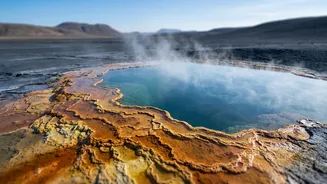
The field of astrobiology uses the search for life elsewhere to better understand life on Earth. To find life on other worlds, scientists first need to identify potential "biosignatures"—gases or chemical imbalances in an atmosphere that could only be produced by living organisms. This forces us to define the most fundamental requirements for life and how it interacts with its environment. For example, the discovery of life in Earth's most extreme environments, from deep-sea hydrothermal vents to acidic volcanic lakes, expands the range of conditions we consider potentially habitable on other planets. This process of looking for life out there sharpens our understanding of how precious, complex, and resilient life is right here.