
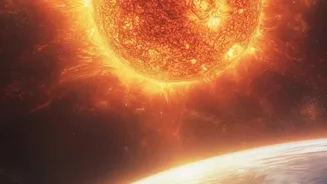
The Sun's Unseen Power
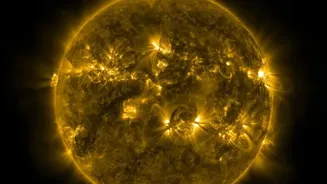
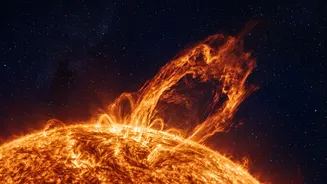
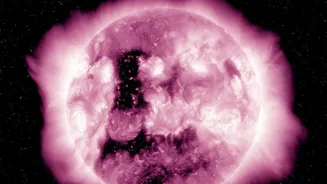
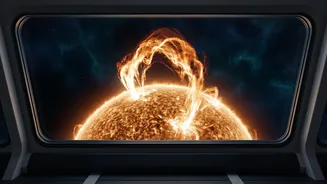
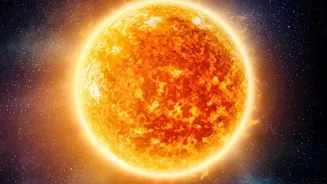
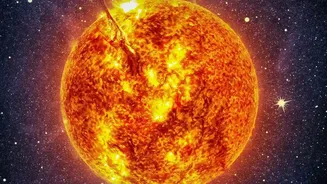
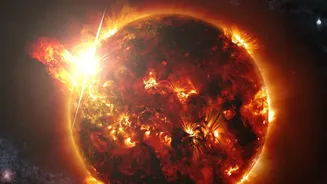
The Sun, our life-giving star, has a volatile side. It sometimes unleashes enormous explosions of plasma and magnetic fields called Coronal Mass Ejections (CMEs). While most drift harmlessly into space, those aimed at Earth can be catastrophic. These
solar storms can travel at speeds up to 3,000 kilometres per second, reaching our planet in as little as 15 hours. When a powerful CME strikes Earth's magnetic shield, it can induce massive electrical currents on the surface. History offers a stark warning. In 1859, the Carrington Event, the most intense solar storm ever recorded, caused telegraph systems worldwide to spark and fail. In today's hyper-connected world, a similar event could cripple power grids, disable satellites, and silence communication networks, causing widespread chaos. More recently, a 1989 storm knocked out power for millions in Quebec, Canada.
The Challenge of Looking into the Sun
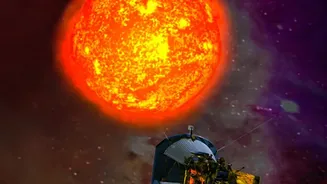
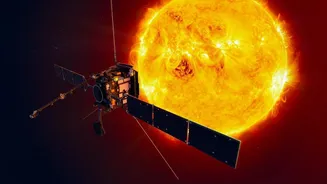
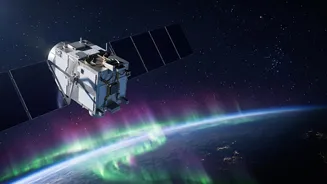
Predicting which CMEs pose a threat is incredibly difficult. Currently, forecasters rely on instruments called coronagraphs, which block the Sun's blinding light to reveal the fainter corona and any eruptions. Human analysts study images from spacecraft like NASA’s STEREO and SOHO missions to determine a CME's size, speed, and direction. This is a time-consuming process that requires immense expertise. Even with satellites positioned between Earth and the Sun, such as the DSCOVR satellite, we often get only 15 to 60 minutes of advance warning before a geomagnetic storm hits. While this is useful, it leaves little time for power companies and satellite operators to take protective measures. For a truly effective defence, we need a faster and more accurate warning system.
AI Enters the Picture
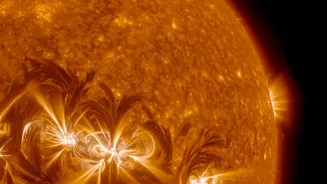
This is where new artificial intelligence research changes the game. Scientists have developed AI models designed to give us that crucial head start. One such model, known as DAGGER, uses a technique called deep learning. It was trained on vast amounts of data from past solar events, learning to identify the subtle relationships between measurements of the solar wind and the resulting geomagnetic disturbances on Earth. Instead of waiting for human analysis, DAGGER can process real-time data from spacecraft and, in less than a second, predict the severity and location of a storm's impact anywhere on the planet. Another recent AI model called EarlyDetect goes even further, spotting the faint acoustic and magnetic signals that precede the formation of active solar regions—the source of storms—nearly nine hours before they become visible.
From Hours to Minutes
The primary advantage of these AI systems is speed. The DAGGER model, for instance, can provide a reliable 30-minute warning before a solar storm hits. While 30 minutes might not sound like much, it is a significant improvement that provides a critical window for action. It is enough time for power grid operators to reroute power and protect vulnerable transformers. Satellite operators can put their spacecraft into a safe mode to prevent damage to sensitive electronics. This shift from a reactive to a proactive stance is a monumental leap in space weather preparedness. As one researcher involved in the DAGGER project noted, this AI makes it possible to make rapid, accurate global predictions and minimise, or even prevent, devastation to modern society.
Why This Matters for India
For a nation as digitally integrated as India, the threat of a solar storm is significant. Our economy relies heavily on systems vulnerable to geomagnetic disturbances. Imagine the disruption if the Unified Payments Interface (UPI) system went down, or if mobile networks and internet services were knocked offline. GPS, essential for everything from logistics and shipping to ride-hailing apps, is also susceptible to interference from solar storms. Major power blackouts could bring cities to a standstill and impact everything from water supply to hospital operations. Improved forecasting gives Indian authorities and companies the chance to brace for impact, safeguarding the critical infrastructure that underpins our daily lives and national security. It transforms solar storm prediction from a scientific curiosity into an essential public safety tool.