





A Planet Where It Shouldn't Be
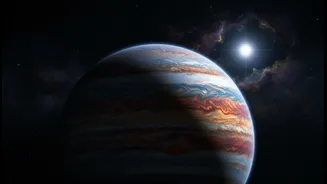
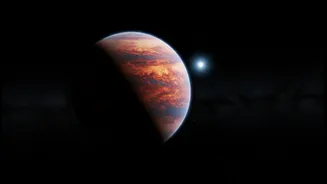
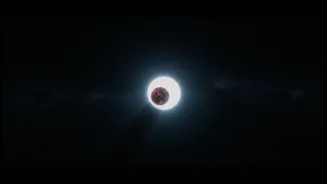
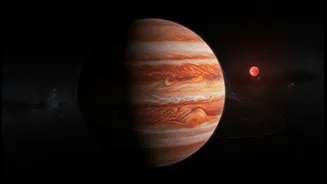
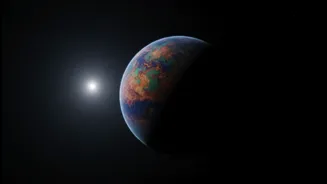
Imagine a world seven times larger than its star. That's the bizarre reality of WD 1856 b. It’s a gas giant, similar in size to Jupiter, but its sun is a white dwarf—a tiny, incredibly dense stellar remnant about the size of Earth. To make things even stranger,
the planet zips around this dead star every 34 hours, orbiting 50 times closer than Earth does to the Sun. This is the cosmic equivalent of a fly circling a pinpoint. For astronomers, this setup is a giant red flag. The planet is simply too close. If it had been in that orbit when the star was alive, it would have been completely destroyed.
The Star's Violent Past
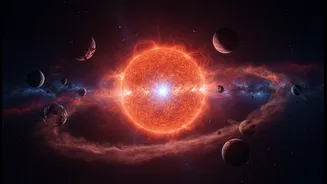
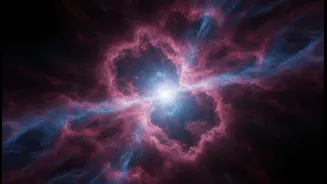
To understand why WD 1856 b is such a survivor, we need to look at its star's brutal history. Most stars, including our own Sun, don't just quietly burn out. Towards the end of their lives, after exhausting their hydrogen fuel, they swell up into enormous red giants. This phase is incredibly destructive; the star expands hundreds of times its original size, engulfing and incinerating any inner planets in its path. After this phase, the star sheds its outer layers, leaving behind its hot, compact core: a white dwarf. Based on this life cycle, any planet in an orbit as tight as WD 1856 b's should have been swallowed whole billions of years ago.
The Great Migration
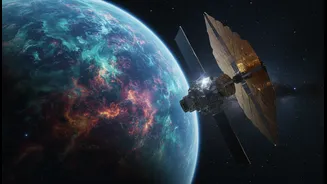
So how did the planet survive? Recent observations from the James Webb Space Telescope (JWST) have provided the crucial clue. Scientists measured the planet's temperature and found it was significantly warmer than it should be, glowing with leftover heat from a past event. After running models, they concluded this heating event happened long after the star had already become a white dwarf. This points to the most likely survival scenario: the planet didn't ride out the storm, it arrived after. Originally, WD 1856 b likely had a wide, safe orbit far from the star's destructive reach. Billions of years later, possibly due to gravitational nudges from two other stars in its triple-star system, it was knocked into a new path that sent it spiraling inward toward the white dwarf. Its interaction with the dead star's immense gravity would have heated it considerably, explaining its current warmth as it continues to cool.
A Glimpse into Our Future
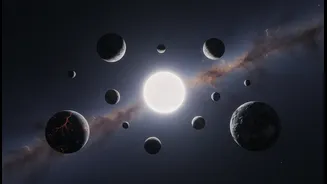
The story of WD 1856 b is more than just a fascinating space drama; it’s a potential preview of our own solar system's distant fate. In about five billion years, our Sun will also become a red giant and then a white dwarf. While planets like Mercury, Venus, and possibly even Earth will be destroyed, the fate of the outer gas giants like Jupiter and Saturn has been an open question. WD 1856 b is the first direct evidence that a giant planet can survive its star's death and end up in a close orbit around the stellar remnant. The James Webb telescope was even able to detect methane and haze in its atmosphere, the first time an atmosphere has ever been detected on a planet orbiting a white dwarf. This opens up a whole new field of study for planets in post-apocalyptic systems.