





Why Fly on Titan?
For decades, planetary exploration has meant either orbiting from above or crawling slowly across the surface with rovers. Dragonfly represents a new paradigm. Titan is a unique target because it is the only moon in our solar system with a dense atmosphere.
Primarily made of nitrogen, like Earth's, its atmosphere is actually four times denser than our own. Combined with a gravity that is only one-seventh of Earth's, Titan is an almost perfect environment for flight. An aircraft can generate significant lift with relative ease, making it possible to create a mobile science laboratory that can leapfrog across vast distances. A rover would be hampered by Titan's vast dunes of organic sand, but Dragonfly can fly over them, exploring dozens of locations hundreds of kilometres apart—a feat impossible for a ground-based vehicle.
Meet the Quadcopter
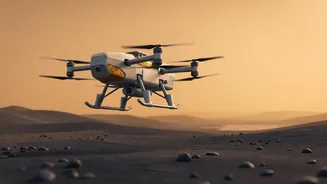
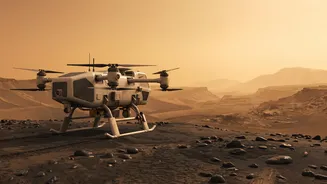
Dragonfly is technically an octocopter, featuring eight rotors arranged in a dual-quadcopter configuration. This design provides redundancy; it can continue to fly even if it loses a motor or rotor. The nuclear-powered lander is roughly the size of a small car and is scheduled to launch in July 2028, arriving at Titan in 2034. Power comes from a Multi-Mission Radioisotope Thermoelectric Generator (MMRTG), the same type of power source used by the Curiosity and Perseverance rovers on Mars. This is necessary because Titan is too far from the sun for solar panels to be effective. For most of its time, Dragonfly will be on the ground, recharging its batteries. A flight will only last about half an hour, covering up to 16 kilometres before it lands to spend the next 16 Earth days (one Titan day, or 'sol') analysing its location and recharging for the next hop.
The Search for Life's Building Blocks
Titan is a top priority for astrobiology because its environment may be similar to that of early Earth. It has a complex cycle of liquids, with clouds, rain, rivers, and seas—but they are made of liquid methane and ethane, not water. The atmosphere is rich in nitrogen and methane, which, when hit by sunlight, creates a complex soup of organic molecules that rain down on the surface. These organic compounds are the building blocks of life as we know it. Dragonfly's primary mission is to study this prebiotic chemistry. It will investigate how far these chemical processes have gone and search for chemical signatures that could indicate past or even present life. Scientists are interested in two possibilities: life as we know it in a potential subsurface ocean of liquid water, and hypothetical life that could exist in the liquid hydrocarbon lakes on the surface.
A Flying Science Laboratory
To achieve its ambitious goals, Dragonfly carries a suite of advanced instruments. Its Dragonfly Mass Spectrometer (DraMS) will analyse the chemical composition of surface materials to identify organic compounds. To collect samples, it's equipped with drills on each of its landing skids that can bore into the surface and pneumatically transfer the material to the mass spectrometer. The Dragonfly Gamma-Ray and Neutron Spectrometer (DraGNS) will determine the composition of the ground beneath the lander. A meteorology and geophysics package will monitor weather and listen for "Titanquakes," while a suite of cameras (DragonCam) will capture breathtaking images of the landscape and help the team scout for the next safe landing spot. Due to the 90-minute communication delay with Earth, Dragonfly's landings must be performed autonomously, using its sensors to identify safe terrain.