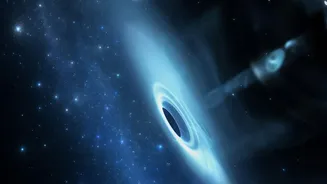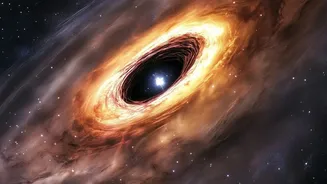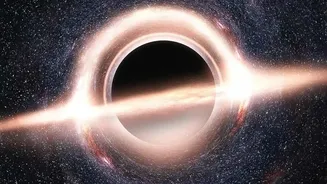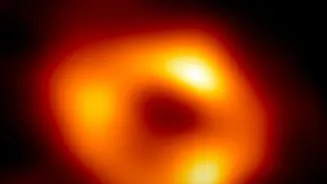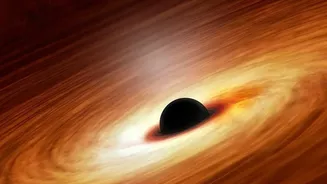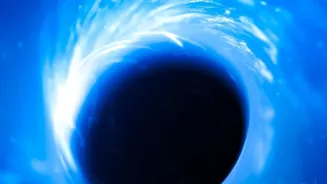






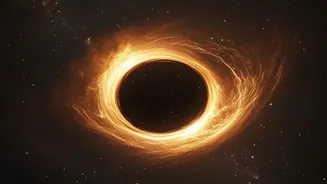

Black holes are the universe's ultimate prisons, famous for pulling things in and never letting them go. For decades, scientists believed they could only merge and grow. But what if they could do the opposite? A new study is asking that very question.
The Unbreakable Cosmic Rule
To understand why the idea of a splitting black hole is so radical, we first need a quick refresher. A black hole is a region of spacetime where gravity is so intense that nothing, not even light, can escape once it crosses a boundary called the event horizon. For decades, our understanding, based on Einstein's theory of general relativity, was that black holes follow a one-way street: they can swallow matter and merge with other black holes to become more massive, but they can't break apart. A key reason for this is a fundamental law of physics related to entropy, a measure of disorder. For a stationary black hole to split into two smaller ones, it would decrease the system's overall entropy, which is considered thermodynamically unfavorable—like an egg spontaneously unscrambling itself.
A New Wrinkle in Spacetime
A recent theoretical study, published in the journal Physical Review D, has poked a small but fascinating hole in this long-held assumption. Researchers investigated the physical laws that prevent a black hole from splitting and searched for potential loopholes. They discovered that under one very specific and extreme condition, the rules might be bendable. The secret ingredient, according to their calculations, is rotation. If a black hole were to spin at, or very close to, its maximum possible speed, the physics could change dramatically. This extreme rotation provides the energy needed to overcome the entropy barrier that would normally forbid a split.
The 'Pair-of-Pants' Theory
So how would this cosmic division actually work? The researchers describe the hypothetical process with a quirky name: a 'pair-of-pants topology'. Imagine the event horizon, the black hole's outer boundary, stretching and deforming over time. In this scenario, it would begin to look like a pair of trousers, with a single waist branching into two separate legs. The original black hole would funnel itself down these two 'legs' of spacetime, eventually emerging as two distinct, smaller black holes. However, there's another major catch. For the split to be successful, the two newly formed black holes would have to separate quickly enough to avoid their own powerful gravity pulling them immediately back into another merger. This requirement narrows the possibility even further, making it viable only for black holes spinning at the absolute physical limit.
From Mathematical Model to Reality
It's crucial to remember that these findings are entirely theoretical. They are the result of complex mathematical calculations, not astronomical observation. As of now, no astronomer has ever seen evidence of a black hole splitting in the wild. The researchers themselves are clear that they cannot yet assign a probability to such an event occurring. They speculate that if it does happen, it would be more likely for smaller, primordial black holes—hypothetical objects that may have formed in the very early universe—rather than the supermassive black holes we observe at the centres of galaxies today. Detecting such a split would be an immense challenge, though some scientists suggest it might be possible to indirectly spot signals, such as bursts of gamma_rays from tiny fragments, with sensitive telescopes.