




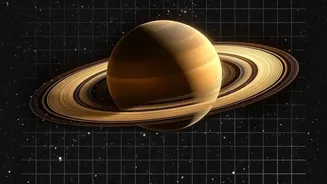
A Planet of Puzzling Shapes
Saturn has long been a source of fascination, not just for its majestic rings, but for its strange and persistent weather patterns. Since the Voyager missions in the 1980s, scientists have known about a massive, six-sided jet stream—a hexagon—swirling
around the planet's north pole. This feature, wider than two Earths, has remained remarkably stable for over 40 years, a geometric marvel in a chaotic atmosphere. For years, astronomers wondered if a similar shape might exist at the south pole. After extensive searches by missions like NASA's Cassini spacecraft, which orbited Saturn from 2004 to 2017, none was found, deepening the mystery of the northern hexagon's uniqueness.
The South Pole's New Decagon
The long-held assumption of a lone polygon has now been shattered. Recent observations have revealed a giant, evolving 10-sided atmospheric wave encircling Saturn's south pole. This newly discovered decagon is a huge structure, a powerful jet stream racing at speeds of around 400 kilometres per hour. The discovery came as a surprise to scientists, who noted its sudden appearance in a region that previously showed no such long-lived formations. The finding was made possible as Saturn's seasonal tilt brought its south pole back into view from Earth after it was hidden from 2012 to 2023.
Hubble's Detective Work
The crucial evidence came from the venerable NASA/ESA Hubble Space Telescope. The initial hints were first spotted by a team led by Agustín Sánchez-Lavega, combining data from ground-based observatories and amateur astronomers in 2024. This prompted a closer look with Hubble's powerful vision. By analysing images from Hubble's Outer Planet Atmospheres Legacy (OPAL) program, which annually monitors the solar system's gas giants, researchers were able to trace the decagon's origins. They found faint, subtle signs of the structure beginning to emerge in images from as far back as 2023, before it became the clearly defined pattern seen in 2025. This rare opportunity allows scientists to watch a giant atmospheric pattern develop in near real-time.
How Do These Shapes Form?
While the exact mechanisms are still being debated, these polygons are thought to be standing waves in Saturn's powerful jet streams. Imagine a fast-flowing river; disturbances can create stable, repeating wave patterns. Similarly, small perturbations in Saturn's atmospheric currents are believed to meander and lock into these remarkably stable geometric shapes. The decagon isn't just a surface-level cloud pattern; observations show it extends deep into multiple layers of the atmosphere, indicating it's a significant, vertically-structured weather system. Computer simulations have shown how such a wave could form, but the precise trigger for the decagon's recent appearance remains a mystery.
A New Chapter in Planetary Science
The discovery of the decagon proves that Saturn's famous hexagon is not as unique as once thought. It shows that these giant planets are far from static, with dynamic weather systems that can evolve and change on a scale of just a few years. Scientists are now eager to continue observing the south pole to see if the decagon will stabilize into a long-lasting feature like its northern cousin or if it's a more transient phenomenon. This finding opens up new avenues for understanding the complex atmospheric dynamics that govern gas giants, not just in our solar system but across the universe.