


Beyond the Visible
The light our eyes can see is only a tiny slice of the full electromagnetic spectrum. Just as there are sounds we can't hear, there are forms of light we can't see, from low-energy radio waves to high-energy X-rays. Different physical processes in the universe
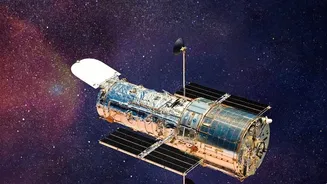
emit different kinds of light. A view in visible light, like from the Hubble Space Telescope, shows us where stars are shining. But it can be misleading. Thick clouds of cosmic dust often block our view, hiding what lies behind. To understand a galaxy's complete life cycle—its birth, life, and death—we need to use telescopes that can see these other forms of light. Each wavelength tells a unique and complementary part of the story.
Infrared: Peering into Stellar Nurseries
Infrared light is the great revealer of secrets. It has longer wavelengths than visible light, allowing it to pass through the dense clouds of cosmic dust that would otherwise appear opaque. This gives astronomers the equivalent of cosmic night vision. When they point an infrared telescope, like the James Webb Space Telescope, at a galaxy, they can peer directly into stellar nurseries where new stars are being born. While the protostars themselves are hidden, they heat up the surrounding dust, causing it to glow brightly in infrared. This allows us to map regions of intense star formation that are completely invisible otherwise. Essentially, the infrared story is the story of creation and hidden heat, showing us the building blocks of galaxies in action.
Radio Waves: Echoes of the Past
At the other end of the energy spectrum, radio waves tell a story of immense scale and ancient history. Radio telescopes, which often look like giant dishes, detect the lowest-energy light. They can reveal vast jets of material, often many times larger than the galaxy itself, that were blasted into space by a central supermassive black hole millions of years ago. These jets are remnants of a galaxy's past active phases. Radio observations also allow astronomers to map out clouds of cold hydrogen gas. This gas is the raw fuel for future generations of star formation. So, while infrared light shows us where stars are currently forming, radio light shows us the fuel reserves for stars that will form billions of years from now, giving us a glimpse into a galaxy's deep past and distant future.
X-Rays: A Universe of Violence
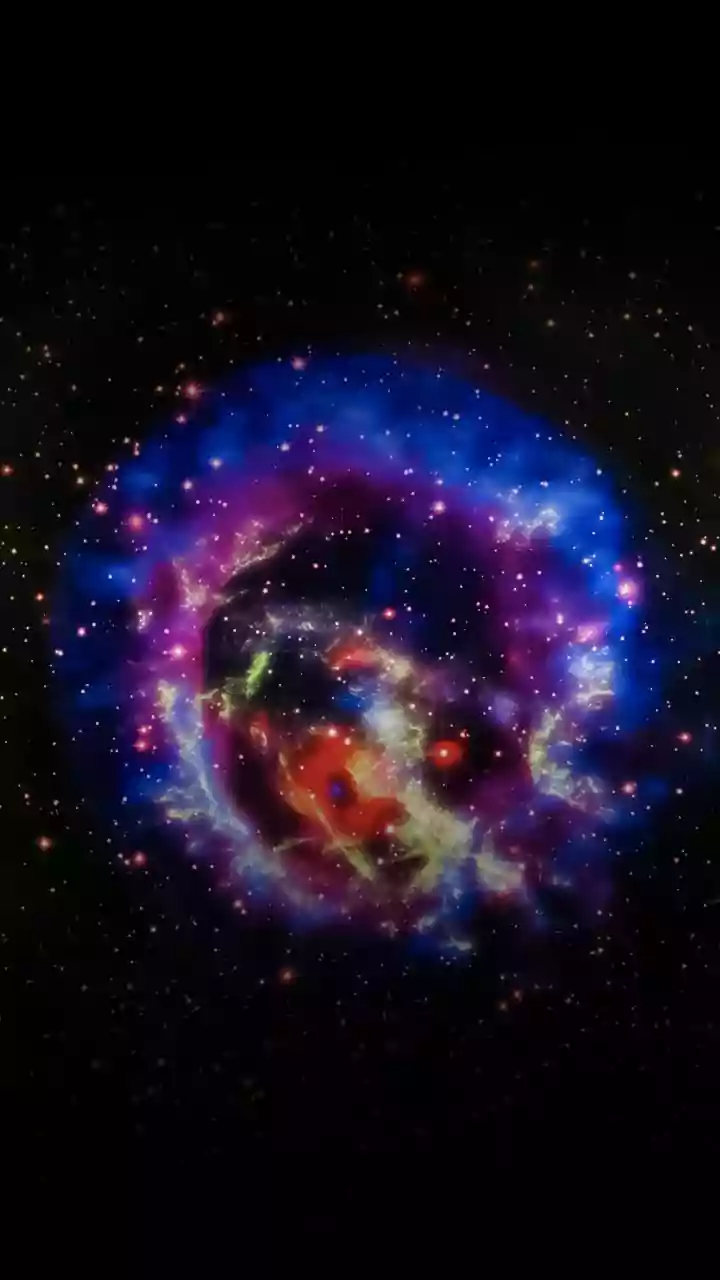
If radio waves show a galaxy's calm history, X-rays reveal its most violent and energetic present. X-rays are very high-energy light, produced by matter heated to millions of degrees. X-ray telescopes like NASA's Chandra Observatory are designed to detect the signature of cosmic chaos. This includes material being superheated as it’s devoured by a supermassive black hole at the galactic center. X-rays also show us the glowing remnants of exploded stars, or supernovae, which blast chemical elements out into space. Essentially, anything involving extreme speed, temperature, and energy—from colliding stars to powerful black hole outflows—shines brightly in the X-ray spectrum. Viewing a galaxy in X-rays is like reading the most dramatic and action-packed chapter of its story.
The Complete Picture: Centaurus A
No single wavelength tells the whole story. The real power comes from combining them. Take the galaxy Centaurus A, about 13 million light-years away. In visible light, it looks like a standard elliptical galaxy sliced in half by a dark lane of dust. But in the infrared, we see through that dust to the glow of young stars. Switch to radio and X-ray views, and a completely different feature dominates: two enormous jets of high-energy particles erupting from the central supermassive black hole. Only by overlaying all these images—from radio, infrared, visible, and X-ray—do we get a complete understanding. We see the visible stars, the hidden star birth, and the violent engine at its core all at once, revealing a complex and dynamic galaxy that is far more than what our eyes alone could ever perceive.