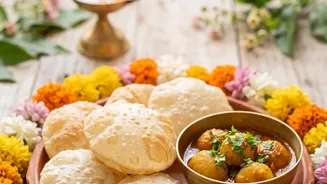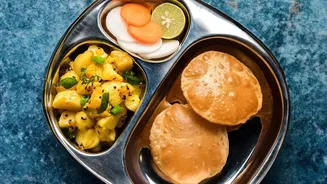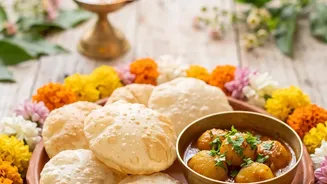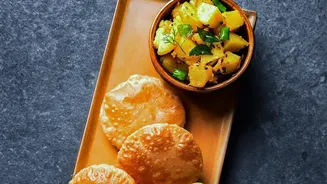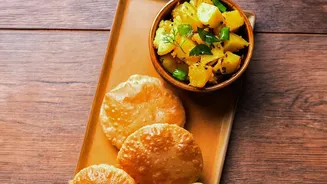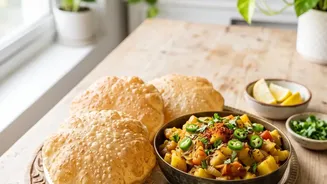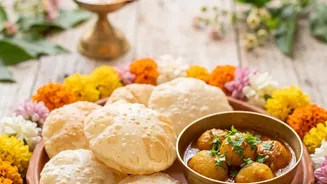



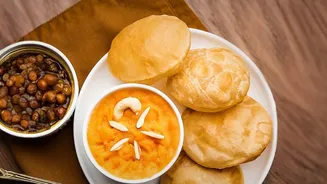
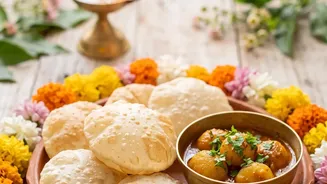
There are few sights more comforting than a plate of hot, puffed-up puris served next to a flavourful sabzi. It's a breakfast that transcends state lines and generations, a culinary constant in a country of delightful diversity.
A Symphony of Simplicity
At its heart, Puri Sabzi
is a dish of beautiful contrasts. You have the puri, a simple unleavened wheat-flour dough that magically balloons into a soft, yet slightly crisp, golden orb when deep-fried. Paired with it is the sabzi, which is most often a humble but soul-satisfying potato curry. In its most classic North Indian form, this 'aloo ki sabzi' is a tangy, spicy gravy, often made without onion or garlic, relying on tomatoes and a blend of spices like cumin and coriander for its robust flavour. The magic lies in the act of tearing a piece of the hot puri and using it to scoop up the savoury curry. It's a combination of textures and tastes—soft and crisp, simple and spiced—that is universally appealing.
A Dish for Every Occasion
Puri Sabzi's versatility is a key reason for its enduring popularity. It is just as at home at a bustling street-side stall, served fresh and hot to morning commuters, as it is on a festive platter during special occasions. For many, it's the quintessential lazy Sunday breakfast, a meal that brings the family together. For others, it is an auspicious food, prepared for festivals and religious ceremonies as 'prasadam' or a blessed offering. This ability to be both an everyday comfort and a celebratory treat makes it a unique and cherished part of India's culinary landscape. It is a dish that signifies community, ritual, and simple joys.
A Culinary Tour of India
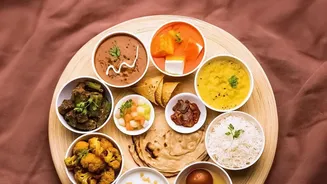
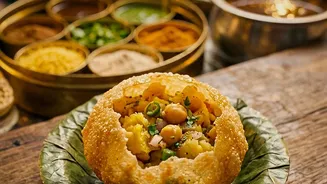
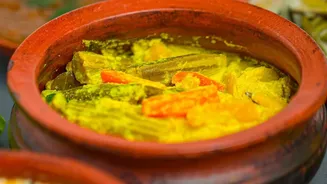
While the combination is classic, every region in India has its own beloved version. In Uttar Pradesh and Delhi, you'll find the hearty 'Bedmi Puri', a thicker puri made with a spiced urad dal paste mixed into the dough, built to be scooped with a spicy aloo curry. Travel east to Bengal, and the puri transforms into the delicate, white, maida-based 'Luchi', often served with a lighter potato curry or a mildly sweet 'cholar dal'. In Punjab, the breakfast of choice is often Puri with Chole, a rich and flavourful chickpea curry. Gujarat offers a 'Masala Puri', where spices are kneaded into the dough itself, while parts of South India serve thinner puris with vegetable kurma or potato masala. This adaptability ensures that no matter where you are in India, a version of this beloved breakfast is never too far away.
More Than Just a Meal
The love for Puri Sabzi goes beyond its taste. It is deeply woven into the fabric of memory and nostalgia. For many, the smell of puris frying evokes childhood mornings and the taste of the sabzi is the taste of home. It’s the meal packed for long train journeys, a comforting presence in a new city. The history of the puri itself is ancient, with fried breads mentioned in texts as early as the 12th century. While the sabzi's key ingredients—potatoes and tomatoes—arrived in India much later, via Portuguese traders, they were wholeheartedly adopted into the cuisine. This evolution is a testament to the dish's ability to adapt and become an integral part of our collective identity. It is not just food; it's an experience that connects us to our past and to each other.