

A Telescope the Size of a Continent
The Square Kilometre Array isn't one telescope, but two of the most advanced radio telescope networks on Earth, managed by the SKA Observatory (SKAO). One part, SKA-Low, is in the remote Murchison region of Western Australia. The other, SKA-Mid, is in the Karoo
desert of South Africa. The name comes from its ambitious goal: to eventually have a total signal collecting area of one square kilometre. Unlike a traditional optical telescope that sees visible light, the SKA is designed to detect faint radio waves that have travelled across the universe for billions of years. These signals carry information about the birth of stars, the nature of gravity, and cosmic events that are invisible to the naked eye. The project is a massive international collaboration, bringing together nations from five continents, including India, to build and operate this next-generation facility.
How Thousands of Antennas Work as One
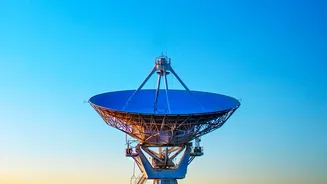
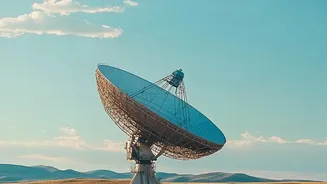
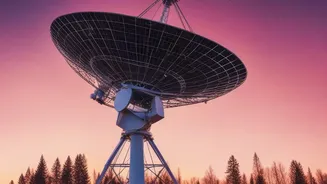
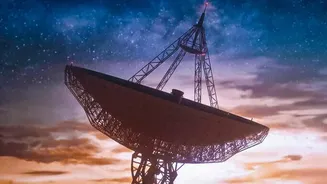
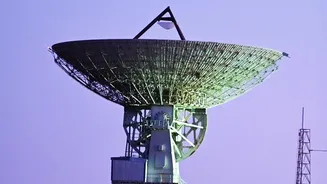
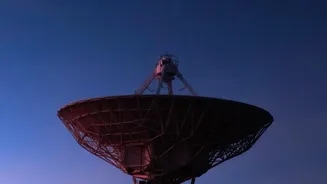
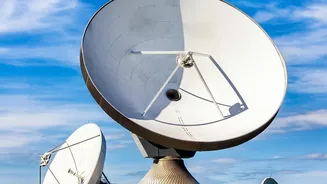
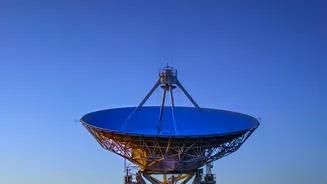
The magic of the SKA lies in a technique called interferometry. Instead of building one impossibly large dish, the SKA uses thousands of smaller antennas spread out over vast distances. In Australia, it employs over 131,000 'Christmas tree-like' dipole antennas for low-frequency waves. In South Africa, it uses nearly 200 large, 15-metre dishes for mid-frequency signals. All these antennas are connected by a massive fibre optic network. When a cosmic radio wave reaches Earth, it hits each antenna at a slightly different time. Supercomputers combine these individual signals, synchronising them with incredible precision. This process allows the network to function as a single, virtual telescope with a diameter equal to the distance between the two farthest antennas—up to 150 km for SKA-Mid. This technique gives the SKA extraordinary sensitivity to detect faint objects and unparalleled resolution to see fine details in the cosmic structures it observes.
The Cosmic Questions SKA Will Answer
The SKA's power will allow scientists to tackle some of the biggest questions in astrophysics. One of its primary goals is to look back to the 'Cosmic Dawn', the era just after the Big Bang when the very first stars and galaxies began to form. Researchers will also use the SKA to test Albert Einstein's theories of gravity with extreme precision by timing signals from pulsars, which are rapidly spinning neutron stars. The telescope will hunt for Fast Radio Bursts, mysterious and powerful flashes of energy from deep space, helping to solve what causes them. Furthermore, the SKA's surveys will map the hydrogen in millions of galaxies to understand their evolution and will scan for complex molecules in space, the potential building blocks of life. While not its main focus, its incredible sensitivity also makes it one of humanity's best tools in the search for extraterrestrial intelligence (SETI).
India’s Crucial Role in the Cosmic Quest
India has been a key player in the SKA project since its early days and became a full member of the SKAO, committing significant funding and expertise. The National Centre for Radio Astrophysics (NCRA) in Pune leads a consortium of Indian institutions contributing to this global effort. India's most critical contribution has been leading the design and development of the Telescope Manager, the complex software system that serves as the 'brain and nervous system' of the entire observatory. This sophisticated software is responsible for controlling the antennas, processing the immense data flows, and ensuring all components work together seamlessly. Indian scientists and engineers are also involved in data processing and hardware development, placing the nation at the heart of the observatory's future operations and discoveries.