




The Glare Problem in Planet Hunting
For decades, finding planets outside our solar system, or exoplanets, has been a monumental challenge. The biggest hurdle is the overwhelming glare of the host star. An exoplanet is billions of times fainter than the star it orbits, making direct observation
akin to spotting a firefly next to a powerful searchlight from hundreds of light-years away. To get around this, astronomers have relied on indirect methods. The most common are the 'transit' method, where a star's light dips slightly as a planet passes in front of it, and the 'radial velocity' method, which detects the tiny wobble a planet's gravity induces in its star. These techniques have been incredibly successful, helping us discover thousands of exoplanets. However, they mostly tell us a planet's size and mass, confirming its existence but revealing very little about the planet itself. They don't tell us if it has an atmosphere, clouds, oceans, or, most tantalisingly, signs of life.
SHAPE: A New Way of Seeing
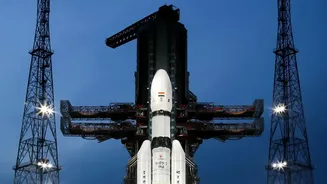
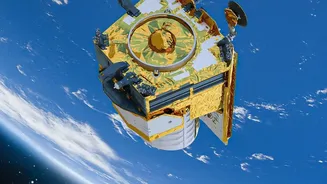
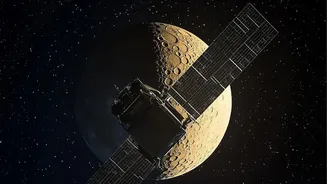
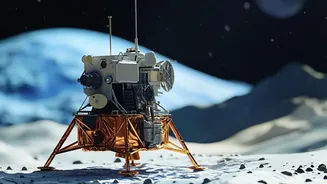
This is where India's SHAPE instrument comes in, representing a major step forward in exoplanet characterisation. SHAPE stands for Spectro-polarimetry of HAbitable Planet Earth. Developed by scientists at the Indian Space Research Organisation (ISRO), it's a unique payload that flew aboard the Chandrayaan-3's propulsion module. Instead of just measuring the brightness of light, SHAPE does something much cleverer: it measures its polarisation. Starlight is generally unpolarised, meaning its light waves vibrate in all directions. However, when this light reflects off a planet's atmosphere or surface, it becomes polarised, with its waves tending to vibrate in a specific direction. SHAPE is designed to detect this faint, polarised, reflected light, effectively filtering out the direct glare from the star. This allows scientists to isolate the planet's light and analyse it in unprecedented detail. Indian scientists have been instrumental in developing this polarimetric method to probe exoplanetary environments.
Learning from Earth to Find Another
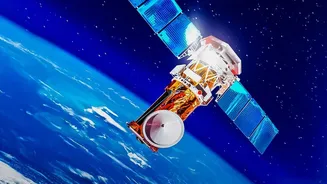
The ingenious part of the SHAPE mission is that it began by looking back at home. From its vantage point in lunar orbit, SHAPE has been observing Earth, treating it as if it were an exoplanet. This provides a crucial baseline. By studying the polarised light reflected from our own living, breathing world, scientists can create a benchmark for what a habitable planet's signature looks like. These observations, made over a range of phase angles as the Moon orbits Earth, allow researchers to build a comprehensive library of Earth's spectro-polarimetric fingerprints. When we eventually turn similar instruments towards distant exoplanets, we will have a reference point. We'll know what the signature of a planet with oceans, continents, and a life-sustaining atmosphere looks like, helping us distinguish promising candidates from barren rocks.
The Search for Atmospheric Biosignatures
The ultimate goal of this technology is the search for biosignatures—substances or phenomena that provide evidence of life. By breaking down the polarised light from an exoplanet into its constituent colours (a technique called spectroscopy), SHAPE can analyse its chemical composition. This could reveal the presence of key molecules in a planet's atmosphere, such as oxygen, ozone, water vapour, and methane. On Earth, the abundance of oxygen is a direct result of biological processes like photosynthesis. Detecting a similar atmospheric composition on a distant world would be one of the most compelling signs of potential life we could find. Polarimetry is particularly sensitive to the properties of clouds, including their composition and particle size, which are crucial for understanding a planet's climate and habitability but are difficult to determine using light intensity alone. SHAPE's technology paves the way for future, more powerful telescopes to hunt for these very chemical fingerprints of life across the galaxy.
India's Growing Role in Exoplanet Science
The SHAPE experiment firmly places India at the cutting edge of a new era in exoplanetary science. While past efforts have focused on discovery, the future lies in characterisation. India has steadily built its capabilities in this field, with instruments like the PARAS spectrograph at the Mount Abu Observatory making several exoplanet discoveries. The development of SHAPE showcases the nation's expertise in creating compact, sophisticated instruments for deep-space missions. The data gathered by SHAPE will not only advance our understanding of Earth but also provide a crucial testbed for the technologies that will be used in next-generation missions, such as NASA's future Habitable Worlds Observatory. By proving this technique, Indian scientists are contributing a vital tool to the global search for life beyond our solar system.