






2001: A Space Odyssey (1968)
You can't start a list like this anywhere else. Stanley Kubrick's masterpiece set the standard for what cinematic space could look like: silent, majestic, and terrifyingly real. Long before digital effects became the norm, Kubrick and his team, including
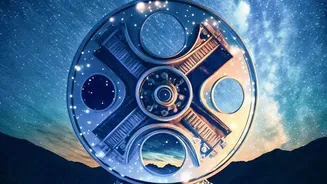
visual effects pioneer Douglas Trumbull, used painstakingly detailed models, clever camera work, and groundbreaking techniques like front projection and slit-scan photography. The result is a film that feels less like a story being told and more like a documentary shot in the future. The iconic 'Star Gate' sequence, a psychedelic trip through light and colour, was created using a custom machine and remains one of the most abstract and awe-inspiring visuals ever put to film. Decades later, its depiction of zero-gravity movement and the cold mechanics of space travel still feels startlingly authentic.
Blade Runner 2049 (2017)
While much of its action is Earth-bound, the visual scope of 'Blade Runner 2049' is cosmic in scale. Cinematographer Roger Deakins, who finally won an Oscar for his work here, created a future that is both hauntingly beautiful and oppressively vast. The film's imagery—from the smog-choked, neon-drenched Los Angeles to the eerie, orange-hued emptiness of a radioactive Las Vegas—paints a portrait of a world straining at its seams. The production design is impeccable, with sharp, geometric buildings and barren landscapes that create a sense of profound human insignificance. It's a different kind of cosmic imagery, one that explores the 'off-world' not by showing it, but by detailing the decaying planet left behind. Each frame is a perfectly composed painting, designed to be absorbed on the largest canvas possible.
Gravity (2013)
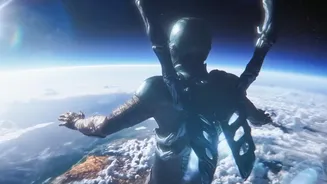
Few films have captured the sheer terror and breathtaking beauty of being adrift in Earth's orbit like 'Gravity'. Director Alfonso Cuarón and cinematographer Emmanuel Lubezki created an experience that is both intensely claustrophobic and balletically graceful. The film won seven Academy Awards, including Best Director and a slew of technical honours for its visual effects, cinematography, and sound design. Using a combination of cutting-edge CGI and innovative filming techniques, the movie places you right inside the helmet of Sandra Bullock's character as she tumbles through a debris field. The long, unbroken shots create a seamless and immersive feeling of weightlessness and peril. It is a technical marvel that turns a disaster in low-Earth orbit into a visually stunning spectacle of survival.
Interstellar (2014)
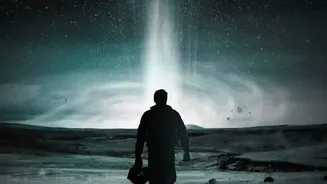
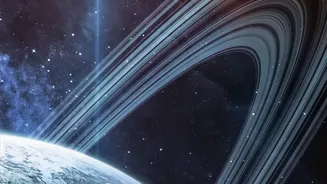
Christopher Nolan's 'Interstellar' took audiences on a journey not just to other planets, but to the very edge of our understanding of physics. The film is famous for its scientifically grounded depiction of a black hole, named Gargantua. Working with theoretical physicist Kip Thorne, the visual effects team developed new software to accurately simulate gravitational lensing—the way a massive object bends light around it. This collaboration was so successful it even led to the publication of scientific papers. The resulting image of a glowing accretion disk forming a halo around a perfect sphere of blackness is one of modern cinema's most iconic and scientifically rigorous visuals. From the colossal tidal waves on Miller's planet to the silent, star-dusted journey through a wormhole, 'Interstellar' is a film that truly conveys the awesome scale of the universe.
Dune (2021 & 2024)
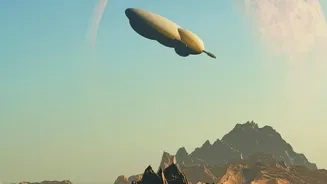
Denis Villeneuve's adaptation of Frank Herbert's epic novel is a masterclass in world-building on a galactic scale. The desert planet of Arrakis is presented with a sense of brutalist grandeur and desolate beauty. The film's visual language is all about scale: colossal sandworms dwarfing humans, impossibly large spaceships emerging from the haze, and vast armies assembling in meticulously designed formations. The cinematography emphasizes the sheer size of everything, making human struggles seem both epic and insignificant against the backdrop of the cosmos. The muted, sand-swept colour palette gives the film a unique, tangible aesthetic that feels ancient and futuristic at the same time. This is not just a story set in space; it is an exercise in creating a fully-realized, visually distinct corner of the universe that is meant to overwhelm the senses.