


A Violent, Crowded Past
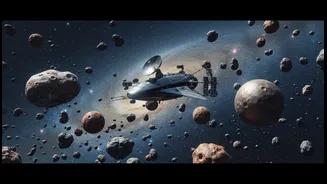
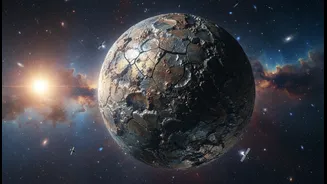
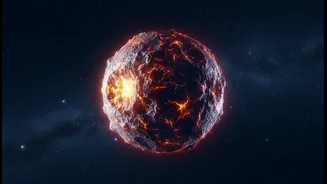
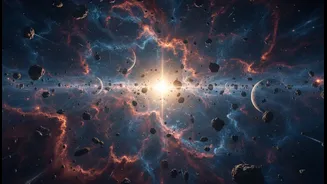
The eight planets we know today may be the survivors of a cosmic demolition derby. For years, astronomers have built models suggesting the early solar system was a tumultuous place, filled with dozens of planet-sized objects, or protoplanets, all jostling
for position. This formative period, lasting millions of years, was marked by catastrophic collisions. Most of these early worlds were either consumed by larger bodies like Jupiter, thrown into the sun, or ejected from the solar system entirely to drift forever in interstellar space. But some may have left clues behind. Recent evidence suggests that by studying everything from meteorites found on Earth to the moons of other planets, we can begin to piece together this lost history.
The Ghost in Our Machine: Theia
The most famous of these hypothetical lost worlds is Theia. According to the widely accepted giant-impact hypothesis, about 4.5 billion years ago, a Mars-sized planet named Theia slammed into a still-forming Earth. The cataclysmic impact was powerful enough to obliterate Theia and blast a massive amount of molten debris from both planets into orbit. This debris eventually coalesced to form our Moon. For decades, the main evidence was that lunar rocks, brought back by Apollo astronauts, share a remarkably similar isotopic signature to rocks on Earth, suggesting a common origin. But the story didn't end there. A bigger question remained: if Theia was destroyed, where did all the pieces go?
Finding a Lost Planet Deep Inside Earth
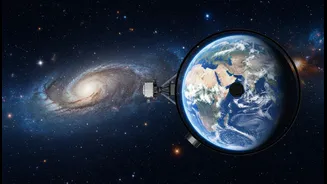
In a stunning discovery, scientists now believe they have found the remnants of Theia buried deep within our own planet. Using seismic waves from earthquakes, geologists have mapped out two continent-sized blobs of unusually dense material sitting on top of Earth's core, one under Africa and one under the Pacific Ocean. These mysterious zones are known as Large Low-Shear-Velocity Provinces (LLSVPs). Advanced computer simulations have shown that a collision with an iron-rich, dense planet like Theia could explain their existence perfectly. The models suggest that after the impact, large portions of Theia's denser mantle sank through Earth's own mantle, eventually settling near the core where they remain to this day.
The Cosmic Detective Work to Come
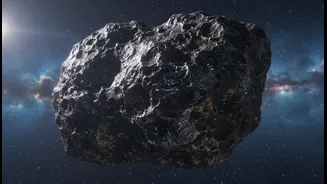
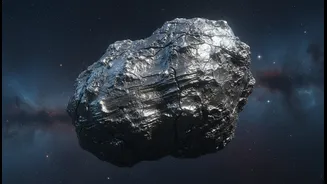
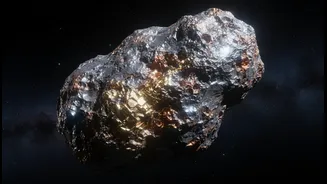
Finding Theia's remains has energized the hunt for other lost worlds. Future observations will be crucial. NASA's Artemis missions, which aim to return humans to the Moon, will gather new lunar samples that could provide even more definitive chemical fingerprints of the Earth-Theia collision. At the same time, meteorite analysis continues to yield surprises. A recent study of a rare meteorite found in the Sahara Desert suggests it originated from another large, destroyed planet from the solar system's early days. Furthermore, advanced telescopes like the James Webb Space Telescope and the upcoming Habitable Worlds Observatory are designed to analyze the composition of distant objects with incredible precision. By studying the chemical makeup of asteroids—many of which are fragments of larger bodies—scientists could identify other planetary ghosts. This technique, called spectroscopy, can read the elemental composition of an object from the light it reflects or emits.
Why This Cosmic History Matters
Reconstructing our solar system's tumultuous past does more than satisfy curiosity. Understanding how planetary systems evolve, and how many planets survive, is key to understanding how rare a stable, life-bearing planet like Earth might be. The discovery that our own system's history was shaped by wandering and colliding planets helps explain the orbits and compositions of the worlds we see today, from Uranus's strange tilt to the makeup of the asteroid belt. By searching for these lost siblings of Earth, we are learning more about the violent and unpredictable processes that ultimately made our own existence possible. The seemingly empty space between the planets may be haunted, and astronomers are just beginning to learn how to listen to its ghosts.