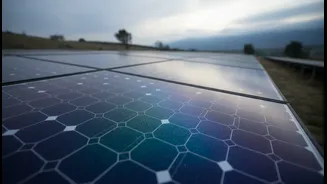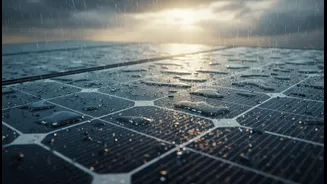

The Monsoon Conundrum
India is a global leader in solar power, with ambitious targets to expand its renewable energy capacity. The country is blessed with abundant sunshine for most of the year, making solar a cornerstone of its strategy for energy independence and climate
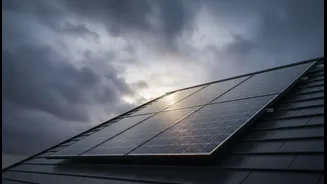
action. However, for three to four months every year, the monsoon season brings dense cloud cover and heavy rainfall, drastically reducing the output of conventional solar panels. Panels that perform optimally on a clear, sunny day can see their generation capacity drop by as much as 70-90% during heavy overcast conditions. This seasonal variability is a major challenge for grid stability and energy planning, forcing a reliance on other, often non-renewable, power sources to fill the gap. This annual slump not only affects large-scale solar farms but also millions of rooftop installations on homes and businesses across the nation.
A Breakthrough from Sun and Rain
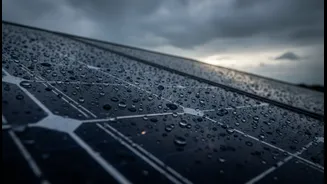
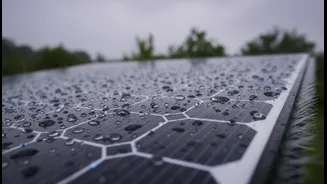
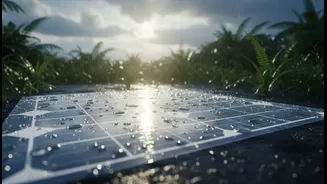
Now, a groundbreaking development in material science offers a potential solution. Researchers, primarily in Spain and China, have created a hybrid solar device that can generate electricity from two different sources: sunlight, like a conventional panel, and the physical impact of falling raindrops. This is not science fiction, but the result of combining two advanced technologies into a single unit. The system integrates highly efficient but moisture-sensitive perovskite solar cells with a protective layer that also functions as a triboelectric nanogenerator, or TENG. This dual-functionality means that during a sunny day, the panel works as a high-efficiency solar cell. But when the monsoon clouds roll in and it starts to rain, the panel switches gears to harvest energy from the rain itself.
How It Generates Power from Raindrops
The magic lies in the triboelectric effect — the same principle that causes a static shock when you touch a doorknob after walking across a carpet. Scientists have developed a patented, ultra-thin coating, just 100 nanometres thick, that is applied to the solar cell. This layer serves two crucial purposes. First, it acts as a durable, water-resistant shield, protecting the delicate perovskite material from the moisture and humidity that would normally cause it to degrade. Second, this coating is a triboelectric surface. When a raindrop strikes it, the friction and contact create a separation of charge, generating a small electrical current. While the power from a single drop is small, the collective impact of thousands of drops during a downpour can be significant. In lab tests, the impact of a single drop has been shown to generate over 100 volts, enough to power small electronics.
A Game-Changer for India's Energy Grid
For a country like India, with its distinct monsoon season, the implications are enormous. All-weather solar panels could smooth out the seasonal troughs in renewable energy generation, leading to a more reliable and consistent power supply year-round. This would reduce the dependency on backup power plants during the rainy season and accelerate India's transition to clean energy. Furthermore, the protective nature of the new coating enhances the durability of the solar panels, making them more resilient to India's varied and often harsh climatic conditions, from intense heat and dust to high humidity. This could lead to longer-lasting panels and a better return on investment for both large-scale solar farms and individual homeowners participating in schemes like the PM Surya Ghar yojana.
The Road to Your Rooftop
While this breakthrough is incredibly promising, it's important to have realistic expectations. The technology is still in the advanced research and development phase, and it could be several years before these hybrid panels are commercially available and affordable. Researchers are working to improve the power output efficiency from rain and ensure the manufacturing process is scalable and cost-effective. The initial applications might be for powering remote sensors, IoT devices, or critical infrastructure in areas with extreme weather. However, the pace of solar innovation is rapid. Just as perovskite cells have quickly emerged as a low-cost, high-efficiency alternative to traditional silicon, this all-weather technology could follow a similar path, eventually making its way to rooftops and solar parks across India.