





A Lonely Outpost in the Kuiper Belt
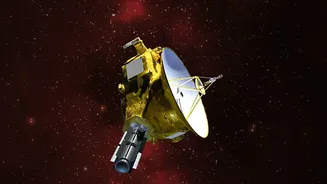
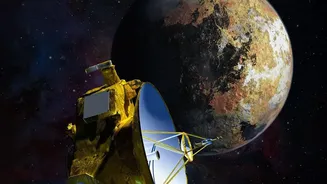
After rewriting the book on Pluto, New Horizons continued its journey into the Kuiper Belt, the vast ring of icy bodies beyond Neptune. In 2019, it performed the most distant flyby in history, studying an object named Arrokoth, which looked like a flattened
snowman. Since then, its mission has shifted. It now acts as a unique observatory, studying the charged particles of the solar wind and the dust environment in a region no other active spacecraft is exploring. Having recently awakened from a nearly year-long hibernation in June 2026, the probe is now more than 9.5 billion kilometres from home, continuing to send back data from the solar system's frigid outer edge.
The Power to Endure
Solar panels are useless in the dim light of the outer solar system. Instead, New Horizons relies on a Radioisotope Thermoelectric Generator, or RTG. This device uses the heat from the natural decay of about 11 kilograms of plutonium-238 to generate electricity. At launch in 2006, the RTG provided about 245 watts of power. By the time it reached Pluto, this had dropped to around 200 watts. The power output continues to decrease by about 3.5 watts per year, but mission planners expect it to have enough energy to run essential systems into the 2030s, making it an invaluable long-term sentinel in deep space.
A Faint Whisper Across Billions of Kilometres
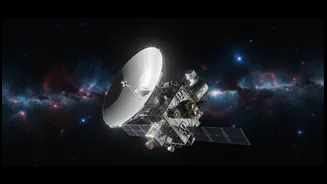
Communicating with New Horizons is an exercise in extreme patience. As of mid-2026, the spacecraft is so far away that its radio signals, travelling at the speed of light, take nearly nine hours to reach Earth. This means a simple command and its confirmation involves an 18-hour round trip. The signal itself is incredibly faint, transmitted from a 12-watt transmitter—about the power of a refrigerator light bulb—and captured by the massive 70-metre antennas of NASA’s Deep Space Network. This global network of dishes is essential for tracking and receiving the precious data from New Horizons and other deep space missions.
Data Returning at a Crawl
The combination of immense distance and low transmitter power means data trickles back to Earth at an incredibly slow rate. Around Pluto, the probe transmitted data at about 1 to 2 kilobits per second, a speed slower than old dial-up modems. Because of this, it took 16 months to download all the scientific data from the few hours of the Pluto flyby. Even with its primary encounters complete, the spacecraft continues to make observations of its environment and other distant Kuiper Belt objects. This slow but steady stream of information is crucial for understanding the heliosphere—the vast bubble of influence our Sun casts into space—and the very structure of our solar system.