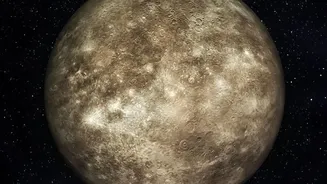




Meet S/2023 U1
The newest confirmed member of the Uranian system is provisionally named S/2023 U1. Announced in February 2024 by the International Astronomical Union's Minor Planet Center, this moon is exceptionally small, with an estimated diameter of just 8 kilometres.
This likely makes it Uranus's smallest known moon. For perspective, Mars's moon Deimos is about 13 kilometres wide. The discovery elevates Uranus's total moon count to 28. In keeping with the planet's literary naming tradition, S/2023 U1 will eventually receive a permanent name from a Shakespearean play.
A Needle in a Cosmic Haystack
Finding such a faint object was a monumental task. The discovery was led by astronomer Scott S. Sheppard of the Carnegie Institution for Science, who described it as one of the faintest moons ever found around an ice giant using ground-based telescopes. The team used the powerful Magellan telescopes in Chile, first spotting the moon on November 4, 2023. Confirming its existence and orbit required special techniques. Astronomers took many long-exposure images over several hours and then digitally layered them, aligning the images to Uranus's movement. This process makes background stars appear as streaks while a moving moon shows up as a single point of light, pulling its faint signal out from the background noise. After the initial sighting, Sheppard and his collaborators at NASA's Jet Propulsion Laboratory were able to find the moon in older images from 2021, which helped solidify its orbital path.
An Irregular and Distant Path
So, what do scientists know about its orbit? S/2023 U1 is what is known as an 'irregular moon'. This means it has a distant, eccentric, and inclined orbit, suggesting it was not formed around Uranus but was instead captured by the planet's gravity long ago. Its orbit is quite long, taking approximately 680 Earth days to complete one trip around the ice giant. The moon's average distance from Uranus is about 8 million kilometres. Because its orbit is so distant, it is only loosely held by Uranus's gravity and is frequently perturbed by the pull of the Sun. Its orbit is also retrograde, meaning it travels in the opposite direction to Uranus's rotation.
Clues to a Chaotic Past
The discovery of S/2023 U1 is more than just adding another name to a list; it provides valuable clues about the history of our solar system. The moon's orbit places it within a grouping of other irregular moons, including Caliban and Stephano. Astronomers believe these groupings are remnants of a larger parent moon that was shattered by a collision with an asteroid or comet billions of years ago. Studying these families of moons helps scientists piece together the timeline of the early solar system, a chaotic era when planetary migration and collisions were common. These tiny, captured worlds are fossils of a bygone age, holding secrets about how the outer planets settled into their current configurations.