




A Messenger From the Stars
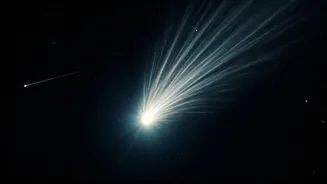
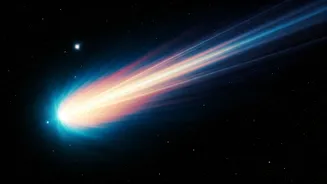
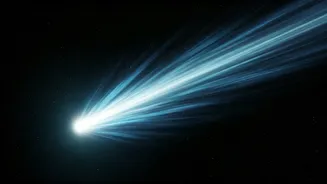
Imagine receiving a package from an unknown sender billions of kilometres away. That's essentially what Comet 3I/ATLAS represents to astronomers. Discovered on July 1, 2025, by the Asteroid Terrestrial-impact Last Alert System (ATLAS) in Chile, this object
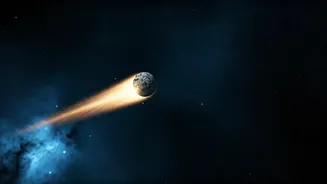
was quickly identified as something special. Its name tells its story: '3I' signifies that it's the third confirmed interstellar object ever detected. Unlike the planets and comets native to our solar system, which are bound by the Sun's gravity into elliptical orbits, 3I/ATLAS is on a hyperbolic trajectory. This means it's moving so fast—at speeds exceeding 200,000 kilometres per hour—that it will only pass through our system once before continuing its journey into the void of deep space. Its incredible velocity is the dead giveaway that it was not born here; it is a true interstellar traveller.
Not Our First Interstellar Visitor
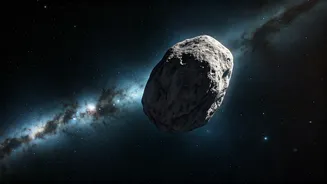
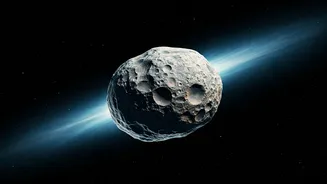
While remarkable, 3I/ATLAS is not the first of its kind. In 2017, the mysterious, cigar-shaped object known as ‘Oumuamua (1I) baffled scientists with its unusual characteristics and lack of a visible cometary tail. Then, in 2019, came 2I/Borisov, which looked and behaved much more like a conventional comet, complete with a fuzzy coma of gas and dust. These first two visitors proved that objects from other star systems do indeed wander through our own, but they also raised more questions than they answered. The discovery of 3I/ATLAS confirms that these are not just one-off events. With each new visitor, astronomers get another data point, another chance to compare and contrast, and another piece of the puzzle of how planetary systems—including our own—are formed across the galaxy.
Why This Comet Is So Special
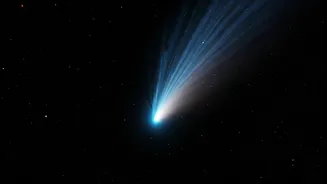
The excitement around 3I/ATLAS stems from the unique opportunity it presents. Unlike the enigmatic 'Oumuamua, 3I/ATLAS is clearly an active comet, spewing gas and dust as it gets warmed by the Sun. This activity is a scientific goldmine. By analysing the light passing through this cloud of material with powerful spectrographs, scientists can determine its chemical composition with incredible precision. It’s like performing a chemical analysis on a piece of another solar system without ever leaving home. Recent studies using the James Webb Space Telescope have already yielded surprising results, revealing a chemical makeup that is distinct from comets in our own solar system. These differences provide clues about the specific conditions in its home star system, which may have been much colder than where our own comets formed.
A Chemical Time Capsule
Think of 3I/ATLAS as a time capsule, carrying information about the primordial materials of its birthplace. Comets are considered leftovers from the dawn of planet formation. Studying one from our own system tells us about our beginnings, but studying one from another star tells us whether our experience is common or unique. For instance, observations of 3I/ATLAS have shown high levels of certain molecules and a ratio of heavy water (deuterium) that differs from our local comets. This might suggest its parent star and planetary system evolved in a very different environment. Some analyses even point to 3I/ATLAS being incredibly ancient, possibly originating from a star system that is billions of years older than our own Sun, giving us a peek into the galaxy's distant past.
The Race to Observe
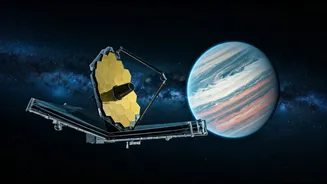
The scientific community is in a coordinated race against time. A global network of telescopes on the ground and in space, from NASA's Hubble and James Webb telescopes to ESA's Juice mission, has been pointed at the fleeting visitor to gather as much data as possible. After making its closest approach to the Sun in late October 2025, the comet is now heading back out into interstellar space. It posed no threat to Earth, passing at a safe distance of about 270 million kilometres. Though it is now moving away, astronomers will continue to track it as long as possible. Each observation adds to a growing library of interstellar objects, paving the way for a new era of comparative planetology, where we can finally begin to understand our place in the cosmic neighbourhood.