
The Infrared Advantage
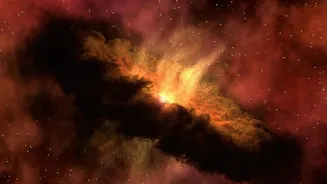
The birth of a planetary system is a messy, chaotic affair. It all happens within vast, dense clouds of gas and dust swirling around a young star. These cosmic nurseries are so thick that they are completely opaque to visible light, hiding the processes
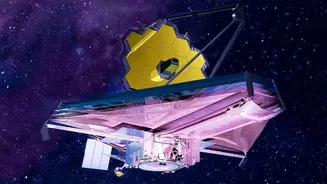
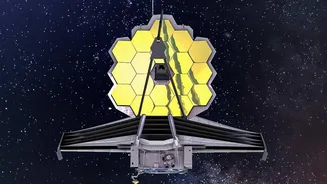
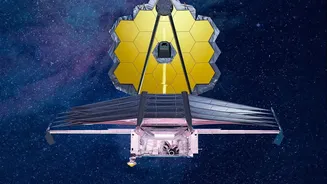
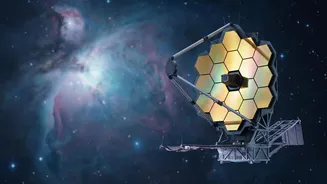
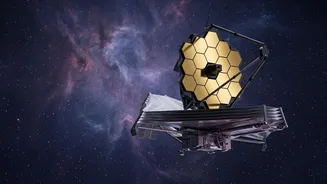
within. This is where the James Webb Space Telescope’s technological prowess shines. Unlike telescopes that see the universe as our eyes do, Webb is optimized to detect infrared light. Infrared wavelengths are much longer than visible light, allowing them to pass through the dense dust clouds that would otherwise block our view. This capability effectively gives astronomers a pass to go inside these stellar nurseries and observe the faint heat glow of dust and the chemical fingerprints of molecules that are the very building blocks of new worlds.
A Window into Protoplanetary Disks
At the heart of every forming system is a protoplanetary disk—a spinning platter of gas and dust that feeds the central star and contains the raw material for future planets. For decades, these disks were largely mysterious, but Webb’s instruments, particularly the Mid-Infrared Instrument (MIRI), are changing the game. MIRI can perform spectroscopy, a technique that breaks down light into its constituent wavelengths, much like a prism creates a rainbow. Each molecule, like water, carbon dioxide, or methane, absorbs and emits light at specific, unique wavelengths. By analyzing the spectrum from a disk, scientists can create a detailed chemical inventory of these planet-forming zones. This allows them to map not just what materials are present, but also their temperature and location within the disk.
Finding the Building Blocks of Worlds
Webb’s scans have already returned a treasure trove of discoveries from these disks. In multiple systems, astronomers have confirmed the presence of water vapor, a crucial ingredient for life as we know it. One key theory confirmed by Webb involves icy pebbles drifting from the cold, outer regions of a disk inward toward the star. As these pebbles cross the “snow line”—the point where it becomes warm enough for ice to turn to vapor—they release large amounts of water into the inner disk, exactly where rocky planets like Earth are thought to form. Beyond water, Webb has detected a surprising diversity of organic (carbon-based) molecules. In some disks, it has found simple hydrocarbons like acetylene, while in others, it has identified more complex molecules like benzene and ethanol for the first time. The detection of the methyl cation (CH3+), a molecule theorized to be a cornerstone of complex carbon chemistry, further supports the idea that the ingredients for life are common in these nascent systems.
From Dust Grains to Giants
Beyond just identifying chemicals, Webb is providing visual evidence of planets in the act of forming. By imaging debris disks, which are the remnants of planet formation, Webb has unveiled intricate structures that hint at the gravitational influence of unseen worlds. For example, observations of the star Fomalhaut revealed not one, but three nested belts of dust and debris, shaped by the gravity of suspected planets. The gaps and rings seen in many of these disks are essentially planetary footprints. As a young planet carves a path through its parent disk, it clears out material, creating a gap. Webb’s ability to resolve these structures with unprecedented clarity helps scientists refine their models of how tiny dust grains first clump together into pebbles, then planetesimals, and finally full-fledged planets. The telescope is not just finding the ingredients; it is watching the recipe unfold in real-time across billions of kilometres.