




A Universe in Wide-Screen
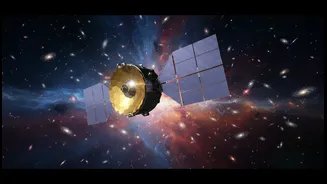
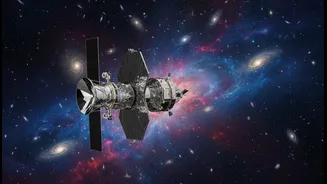
The single most important feature of the Nancy Grace Roman Space Telescope is its immense field of view. Its Wide Field Instrument can capture a patch of sky more than 100 times larger than the Hubble Space Telescope's infrared camera in a single shot.
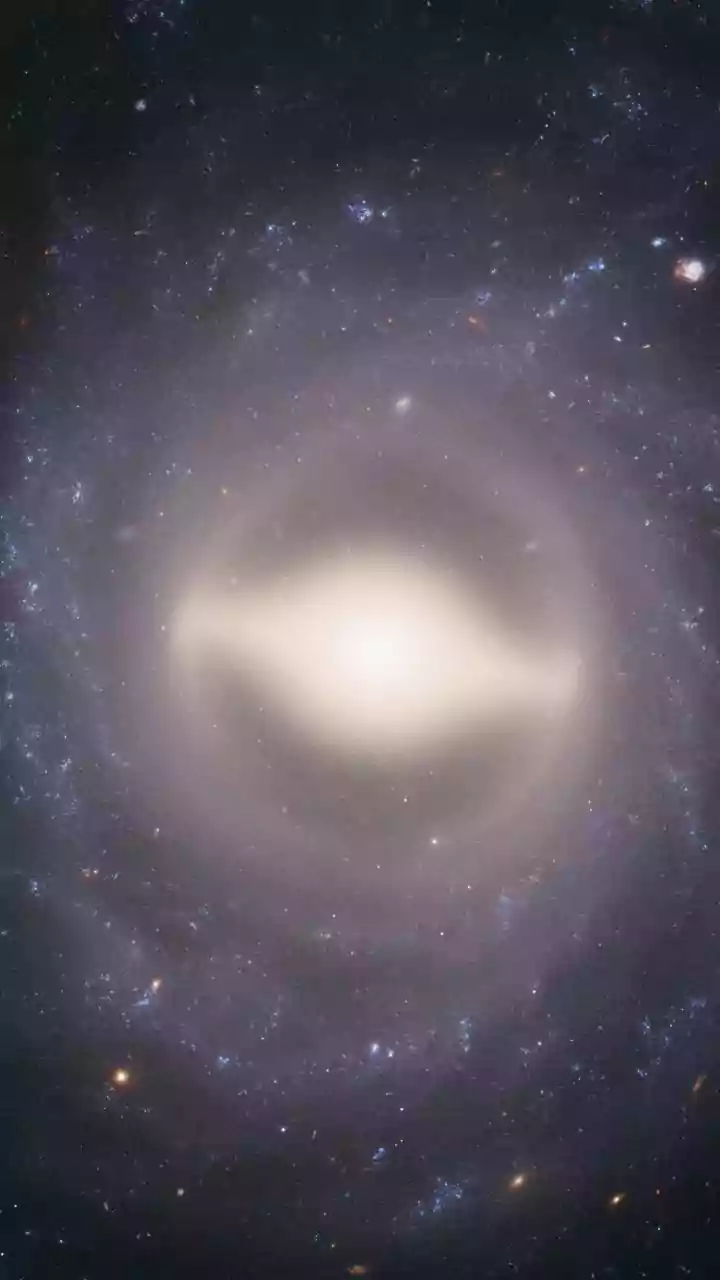
Think of it as the difference between looking at the sky through a drinking straw versus a panoramic window. This capability is not just a minor upgrade; it’s a fundamental shift in strategy. Roman is a survey telescope, designed to efficiently map vast swathes of the universe. Over its five-year primary mission, it will gather more data than Hubble has in over 30 years, creating unprecedented cosmic maps to help scientists tackle two of the biggest mysteries in physics: dark energy and dark matter. By observing the distribution of millions of galaxies and the light from distant supernovae, Roman will provide a massive dataset to test our understanding of cosmic expansion.
Hunting for Planets in a New Way
Roman will also be a prolific exoplanet hunter, but it will use a different primary technique than missions like Kepler or TESS. Its main method will be gravitational microlensing. This phenomenon occurs when a star and a potential planet pass in front of a more distant star, causing the background starlight to be magnified by their gravity. This method is sensitive enough to find planets down to the mass of Mars, including rogue planets that don't orbit any star. Because Roman will be staring at the dense star fields toward the center of our Milky Way, it is expected to discover thousands of new worlds, providing a statistical census of planets that complements other detection methods.
It Is Not Another James Webb
This is perhaps the most crucial limit to understand: The Roman Telescope is not a replacement for or a direct competitor to the James Webb Space Telescope (JWST). They are designed as complementary partners. JWST is built for depth and detail, with a massive 6.5-meter mirror designed to collect faint light from the earliest universe and analyze the atmospheres of individual exoplanets in fine detail. Roman has a smaller 2.4-meter mirror—the same size as Hubble's—and is built for breadth. While JWST stares intently at a small area for a long time, Roman will rapidly scan huge areas. Roman can identify thousands of interesting targets, which Webb could then follow up on for more detailed study.
A More Limited Infrared View
Both Roman and Webb are infrared telescopes, but they don't see the same infrared light. Webb is optimized to see further into the infrared spectrum to capture the highly redshifted light from the universe's first galaxies. To do this, it must be kept incredibly cold, hence its massive, multi-layered sunshield. Roman is observing nearer-infrared wavelengths, which don't require such extreme cooling. This is a deliberate design choice. Roman is not trying to peer back to the absolute dawn of time like Webb; its goal is to study how the universe has evolved on a grand scale and to conduct its exoplanet survey. This makes it a different, but no less powerful, tool for a different set of scientific questions.
The Tech-Demo Coronagraph
Roman will carry a second instrument, the Coronagraph Instrument, which is designed to directly image Jupiter-sized exoplanets by blocking the overwhelming glare of their host stars. However, this instrument is explicitly a technology demonstration. Its primary purpose is to test advanced starlight-suppression technologies that will be crucial for future missions, like the planned Habitable Worlds Observatory, which aims to directly image Earth-like planets. While it will perform groundbreaking science, the coronagraph is not part of Roman's main survey mission and has a much smaller field of view. Its success will be measured in proving the technology works in space, paving the way for the next generation of planet-finders.