






The Rise of the Digital Scribe
AI meeting assistants have emerged as a powerful tool in the modern workplace. These software platforms integrate with video conferencing tools like Zoom, Google Meet, and Microsoft Teams. Once activated, they join the meeting as a silent participant,
diligently recording, transcribing, and summarising the entire conversation. The appeal is obvious: professionals can engage fully in discussions without the distraction of taking notes. After the meeting, they receive a full transcript, a concise summary, and often a list of action items and key decisions, all generated automatically. This technology promises to save professionals hours of manual work, eliminate the risk of missing critical details, and create a searchable archive of every conversation.
In Defence of Pen and Paper
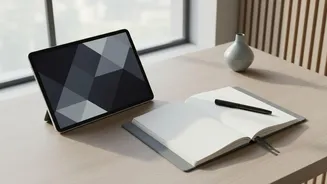
Despite the digital revolution, the simple act of writing by hand holds significant, scientifically-backed advantages. Research consistently shows that taking notes with a pen and paper enhances memory and learning. The process is slower than typing, which forces the brain to process and synthesise information rather than just transcribing it verbatim. This deeper cognitive engagement activates more areas of the brain, creating stronger neural pathways and leading to better recall of concepts. Furthermore, handwriting is less prone to the digital distractions that come with a laptop or phone, allowing for greater focus during a meeting. The physical act of forming letters and the spatial freedom to draw diagrams or mind maps can also spark creativity and deeper understanding.
Where AI Wins: Speed and Scalability
The primary strength of an AI meeting assistant lies in its flawless ability to capture everything. It provides a complete, verbatim record that no human note-taker could ever hope to match. This is invaluable for compliance, detailed project management, or for sharing a perfect record with colleagues who couldn't attend. The output is instantly shareable and, most importantly, searchable. A professional can quickly find a specific comment or decision from a meeting that happened months ago, a feat nearly impossible with stacks of physical notebooks. For teams collaborating across different locations and time zones, this shared, objective source of truth ensures everyone is on the same page, dramatically improving efficiency and accountability.
The Power of Personal Processing
While AI captures what was said, handwriting helps you understand what it means. The very limitations of handwriting are its strength. Because you can't write down everything, you are forced to listen actively, identify the most important points, and summarise them in your own words. This act of real-time synthesis is a powerful learning tool. Studies, including a notable one from 2014, have shown that this deeper processing leads to better conceptual understanding compared to the more superficial, verbatim style of typing. Your handwritten notes become a reflection of your thought process, capturing not just the information but your interpretation and takeaways, which is a uniquely human advantage that AI cannot yet replicate.
The Verdict: A Powerful Partnership
The debate over AI versus handwriting presents a false choice. The most effective professionals will likely find that the two are not competitors, but powerful partners. The ideal solution is often a hybrid approach. Use an AI assistant to create a comprehensive, searchable record of the meeting—the objective 'what'. This serves as your safety net and collaborative tool. Simultaneously, use a pen and notebook to jot down your own key takeaways, action items, and conceptual connections—the subjective 'so what'. This practice engages your mind, cements your understanding, and helps you formulate your next steps. You get the perfect recall of a machine combined with the superior comprehension that comes from manual processing.