


First, What Is a Quasar?
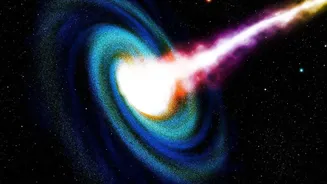
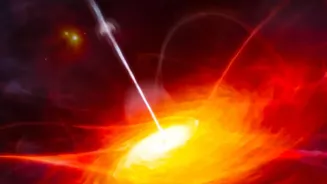
Think of a quasar as a cosmic lighthouse blazing across billions of light-years. The name is short for 'quasi-stellar object' because they look like faint stars. But they are anything but. A quasar is the intensely bright core of a very distant, young
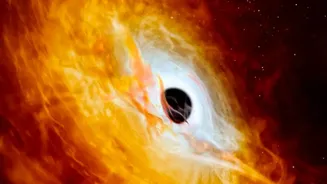
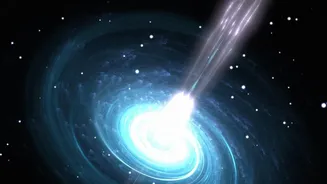
galaxy. This brilliant light is not from stars, but from an 'accretion disk' of gas and dust swirling at incredible speeds around a supermassive black hole at the galaxy's centre. As the material is pulled in by the black hole's immense gravity, it heats up and releases an astonishing amount of energy, often outshining all the stars in its host galaxy combined.
A Discovery Deep in Cosmic Time
Recently, astronomers using JWST data spotted something unusual: a pair of quasars, designated J1602+4228AB, seen as they were just 900 million years after the Big Bang. Finding one quasar from this era is a big deal, but finding two so close together is groundbreaking. This pair, given the Hawaiian name Nāpōwawāʻenakaulua, consists of two supermassive black holes. One is estimated to be 1.5 billion times the mass of our sun, while its companion is around 400 million solar masses. They are separated by just 18,100 light-years—a tiny distance in cosmic terms, roughly one-fifth the diameter of our own Milky Way galaxy. This makes them the most compact quasar pair ever found from this early period.
The Problem: Too Big, Too Soon
Here’s the puzzle that has scientists scratching their heads: these black holes are simply too massive for their age. According to our leading theories of galaxy formation, it takes a lot of time for black holes to grow so large. The standard model, often called 'hierarchical formation', suggests that small structures merge and grow over billions of years. A black hole should need at least a billion years of steady feeding and merging to reach such a colossal size. Yet, this pair—and other recent JWST discoveries—existed when the universe was just a fraction of its current age. As one lead researcher noted, there is no definitive theoretical explanation for how even a single one of these giant quasars can exist so early, let alone a pair.
Rewriting the Rules of Galaxy Growth
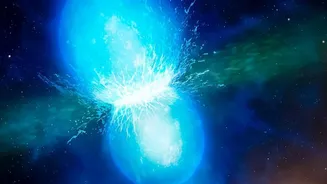
This discovery forces astronomers to consider new, more rapid pathways for galaxy and black hole formation. One leading hypothesis is that this quasar pair is located in an unusually dense patch of the early universe, a sort of cosmic metropolis. In such a crowded environment, galaxy collisions and mergers would have been far more frequent. These chaotic interactions could have provided a massive and sudden supply of gas to the galactic centres, force-feeding the black holes and accelerating their growth at an incredible rate. The discovery of a merging galaxy system known as ZS7, from just 740 million years after the Big Bang, provides further evidence that these mergers were a key driver of rapid growth in the early universe.
Why the JWST Is a Game-Changer
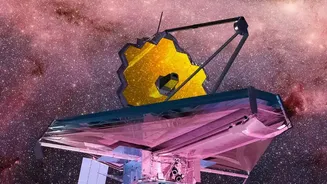
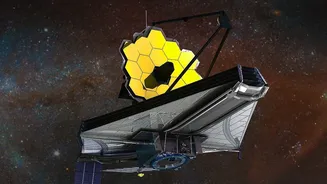
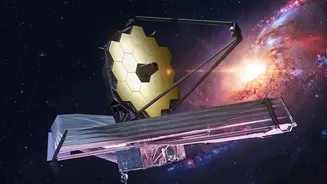
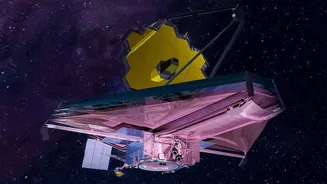
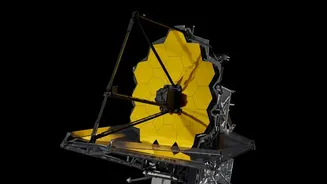
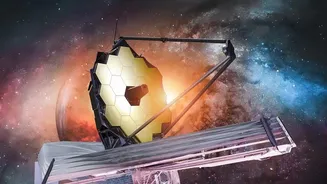
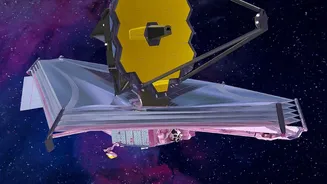
Discoveries like this are only possible thanks to the unique capabilities of the James Webb Space Telescope. Because the universe is expanding, light from the most distant objects is stretched into longer, redder wavelengths. JWST is specifically designed to detect this infrared light, allowing it to see farther back in time than any previous observatory. Its incredible sensitivity and resolution were needed to first spot the faint companion to the brighter quasar, which was then confirmed with ground-based telescopes like Gemini North. The Aether survey, a JWST program to create a census of early universe objects, was instrumental in this find.