




Why Chasing Heat Matters
The search for thermal energy on these icy worlds is fundamentally a search for life’s potential. Heat is a critical ingredient for habitability because it can sustain liquid water and power chemical reactions. On Earth, life thrives around hydrothermal
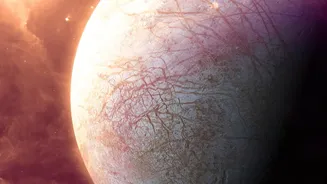
vents on the deep ocean floor, far from sunlight, feeding on chemical energy. Scientists believe similar vents could exist on the seafloors of Europa and Enceladus. Finding hotspots would be the strongest evidence yet that these hidden oceans are not just cold, sterile bodies of water, but dynamic environments with the energy needed to support living organisms.
The Engine Behind the Heat
The warmth doesn't come from the sun, which is a distant pinprick of light in the outer solar system. Instead, it’s generated by a process called tidal heating. As these moons orbit their colossal parent planets, Jupiter and Saturn, they are constantly squeezed and stretched by immense gravitational forces. This relentless flexing creates friction deep within the moons' cores and ice shells, generating a tremendous amount of internal heat. This is the engine that keeps their subsurface oceans liquid and could potentially power geological activity like underwater volcanoes.
Method 1: The Direct Approach with Infrared Eyes
One way to find this heat is to look for it directly. Spacecraft are equipped with sophisticated instruments that can see in the infrared spectrum, which is invisible to the human eye but is emitted by all warm objects. On NASA’s Europa Clipper mission, an instrument called the Europa Thermal Emission Imaging System (E-THEMIS) is specifically designed for this purpose. By scanning the moon's surface, E-THEMIS can create a temperature map, pinpointing any unusual 'hotspots'. These thermal anomalies could indicate places where the ice shell is thinner or where warmer ocean water has recently erupted onto the surface, providing a tantalizing glimpse of the heat below.
Method 2: Analysing Clues from Icy Plumes
Enceladus offers a more direct, if dramatic, way to sample its ocean. The moon famously erupts giant plumes of water vapor and ice particles from deep fractures in its south pole, nicknamed 'tiger stripes'. The Cassini spacecraft flew directly through these plumes, using its instruments to 'taste' their contents. The Ion and Neutral Mass Spectrometer (INMS) and Cosmic Dust Analyzer (CDA) studied the composition of the gas and ice grains. They found water ice, salts, silica, and complex organic molecules, including molecular hydrogen—a key indicator of hydrothermal activity. This chemical fingerprint provided powerful, indirect evidence of a warm, mineral-rich ocean interacting with a rocky seafloor.
Putting It All Together with Europa Clipper
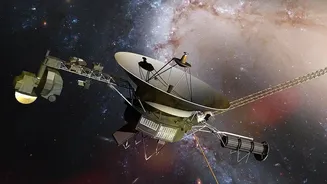
NASA's Europa Clipper, which launched in October 2024, carries a full suite of instruments to investigate Europa's potential habitability. Besides the E-THEMIS heat detector, its Mapping Imaging Spectrometer (MISE) will analyse surface composition to identify salts and organics. Its ice-penetrating radar, REASON, will measure the thickness of the ice shell and search for pockets of liquid water trapped within it. Meanwhile, its ultraviolet spectrograph (Europa-UVS) will search for evidence of plumes similar to those on Enceladus. By combining data from all these instruments, scientists will build the most complete picture yet of this mysterious ocean world.
The Future of Subsurface Exploration
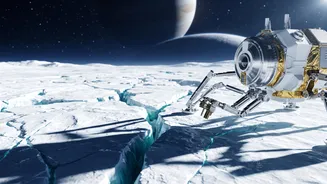
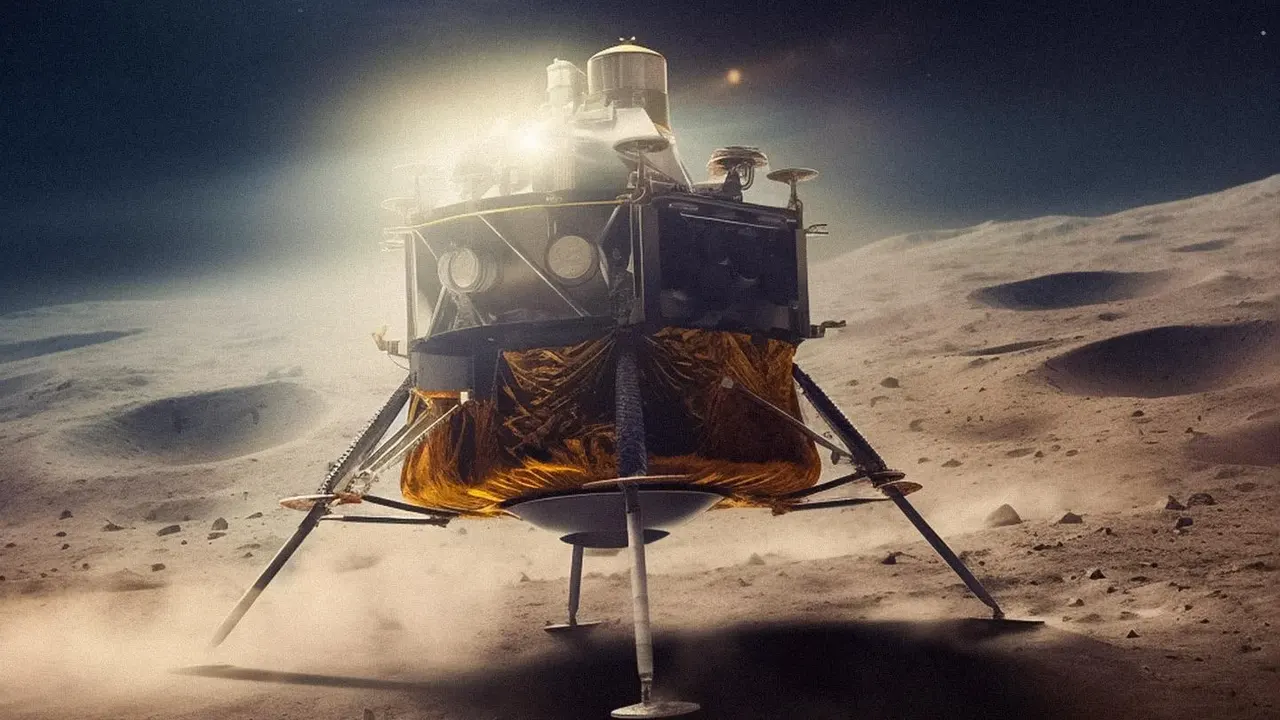
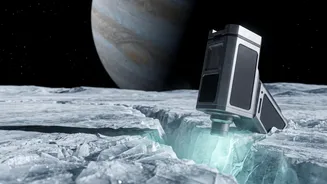
While current missions are designed to study these oceans from orbit, future concepts aim to go a step further. Engineers are developing concepts for landers that could one day touch down on the ice. Some ambitious proposals include 'cryobots' or thermal probes, like the German-developed IceMole, designed to melt their way through kilometres of ice to reach the ocean directly. Such a mission would represent the next great leap in exploration, allowing a submersible to finally explore these dark, alien seas and search for life at its source.