



The Universe's Standard Story
For decades, cosmologists have had a remarkably successful framework for understanding the universe, known as the Lambda-Cold Dark Matter (ΛCDM) model. Think of it as the universe's official biography. It states that after the Big Bang about 13.8 billion
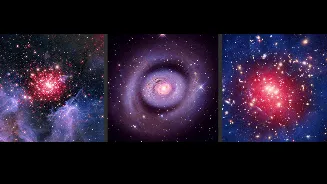
years ago, the cosmos was filled with a hot, dense soup. As it expanded and cooled, gravity slowly went to work, pulling together mysterious, invisible 'cold dark matter' into clumps. These clumps acted as cosmic seeds, their gravity attracting ordinary matter, which eventually formed the first stars, galaxies, and, over billions of years, the vast galaxy clusters we see today. A galaxy cluster is an immense structure containing hundreds or thousands of galaxies, all bound together by gravity and embedded in a halo of hot gas and dark matter. According to the ΛCDM model, these giants should be late bloomers, taking a very long time to assemble.
A 'Crisis' in the Cosmos
Lately, however, this standard story has run into some trouble, leading to what some call a 'crisis in cosmology'. The main issue, known as the 'Hubble Tension', is that different methods for measuring the universe's current expansion rate give conflicting results. Measurements of the 'local' universe, using objects like supernovae, suggest it's expanding faster than measurements of the 'early' universe, derived from the afterglow of the Big Bang, would predict. This discrepancy suggests our understanding might be incomplete. It's like having two different witnesses describe the same event in contradictory ways. Scientists have been working to figure out if the problem is a measurement error or a hint that the ΛCDM model is missing a key piece of physics.
The Surprise Witnesses
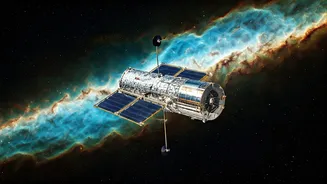
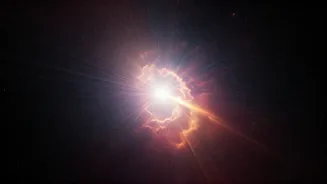
Now, the James Webb Space Telescope (JWST) and other powerful observatories like the Chandra X-ray Observatory have called a new set of witnesses to the stand: ancient galaxy clusters. The JWST, with its ability to peer deep into the cosmic past, is finding structures that simply shouldn't exist so early in the universe's history. One such object, a protocluster designated JADES-ID1, was spotted as it was forming just one billion years after the Big Bang. Before this, most models predicted that protoclusters wouldn't start forming until about three billion years after the Big Bang. JADES-ID1 showed up at least a billion years too early for the party.
Too Big, Too Soon
It's not just their timing that's problematic; it's their size and maturity. The JADES-ID1 protocluster already contained at least 66 galaxies and had a total mass about 20 trillion times that of our sun. Another cluster, XLSSC 122, seen as it was about 3.4 billion years after the Big Bang, looks as massive and concentrated as clusters found much closer to us in time. These discoveries present a major challenge. The standard ΛCDM model is a story of slow, gradual growth. Finding such well-established, massive structures so early on is like finding a fully grown oak tree in a field where you only expected to see saplings. It suggests the process of cosmic structure formation was happening much more rapidly than predicted.
Rewriting the Cosmic Rules?
These findings don't necessarily mean the entire ΛCDM model is wrong. It has successfully explained a vast range of cosmic observations, from the Big Bang's afterglow to the large-scale web of galaxies. However, the early appearance of these massive clusters, along with other JWST puzzles like impossibly large early black holes, suggests the model needs some serious revisions. Scientists are now exploring new theories. Perhaps the initial seeds of structure in the universe were larger than we thought. Maybe dark matter isn't completely 'cold' and interacts with itself in ways we don't yet understand, accelerating early growth. These early clusters are forcing a re-evaluation of the fundamental rules governing how the universe built its largest structures.