



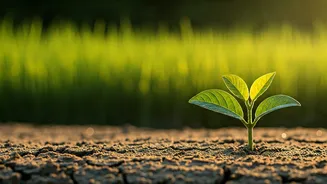


More Than Just Planting Trees
For decades, environmental education in India was often a token gesture—a chapter in a science textbook, a tree-planting drive on World Environment Day. While well-intentioned, it rarely translated into sustained action or deep understanding. Today, that
is changing. 'Green learning' has evolved into a comprehensive approach that integrates principles of sustainability, climate literacy, and ecological justice directly into the curriculum and school culture. It’s about teaching students not just *what* the problems are (pollution, deforestation, climate change) but also *how* to think critically about solutions. This new approach focuses on hands-on experience, problem-solving, and understanding the intricate link between human activity and environmental well-being. It’s about building a generation that sees sustainability not as a subject, but as a way of life.
Why Now? The Forces Driving the Change
Several factors are converging to turn this educational shift into a genuine movement. Firstly, the tangible impacts of climate change are impossible for young Indians to ignore. From the recurring floods in Assam and Kerala to the suffocating air quality in Delhi and the water scarcity in Chennai, the climate crisis is a part of their lived reality. Secondly, there’s a strong policy push. India's National Education Policy (NEP) 2020 explicitly calls for integrating environmental awareness and sensitivity into all stages of schooling. This has given institutions a formal mandate to move beyond rote learning. Thirdly, the global youth climate movement, inspired by figures like Greta Thunberg, has found a powerful echo in India. Young Indian activists are creating their own platforms, demanding accountability, and proving that they are not just passive recipients of knowledge but active agents of change.
From Classroom Theory to Community Action
The most exciting aspect of this movement is its practical nature. Across the country, schools are becoming living laboratories for sustainability. In Bengaluru, students are leading waste segregation programmes that manage the entire school's refuse, turning organic waste into compost for school gardens. In parts of rural Maharashtra, schoolchildren are participating in water conservation projects, learning to build check dams and measure groundwater levels. Organisations like the Centre for Science and Environment (CSE) run the 'Green Schools Programme,' which encourages schools to conduct rigorous audits of their use of water, energy, land, and air. This isn't just about a grade; it's about collecting real-world data and creating action plans that reduce the school's ecological footprint. Students learn data analysis, project management, and community engagement, all while making a measurable difference.
The Student-Led Charge
Crucially, this is not a purely top-down movement dictated by educators. Students are increasingly in the driver's seat. They are forming 'Eco Clubs' that do more than just beautify the campus; they are launching campaigns to eliminate single-use plastics, organising awareness drives in their local communities, and using social media to amplify their message. They question canteen suppliers about food sourcing, lobby school administration for solar panels, and demand better public transport. This proactive stance is the hallmark of the movement. It signifies a fundamental shift from viewing children as future citizens to recognising them as present-day stakeholders with a voice and the power to influence their environment right now.
Challenges on the Path to Green
Despite the incredible momentum, the path forward is not without obstacles. The quality and depth of green learning remain highly inconsistent. The movement is currently most visible in well-resourced urban private schools, and there is a significant risk of creating a 'green divide'. For environmental education to be truly transformative, it must be accessible to every child in every corner of the country. This requires massive investment in teacher training, as many educators feel ill-equipped to teach a subject that is constantly evolving and requires a multidisciplinary approach. Furthermore, developing a standardised yet locally relevant curriculum that can be adapted across India’s diverse ecological zones is a monumental task. Without addressing these systemic issues of equity and capacity, the movement risks remaining a collection of inspiring anecdotes rather than a nationwide revolution.