






Earth's 'Evil Twin' as a Climate Lab
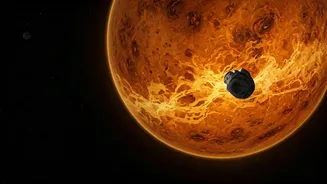
Venus is often called Earth’s twin because of its similar size and mass, but its environment is anything but friendly. The planet is a cautionary tale of a runaway greenhouse effect, with a crushing atmosphere composed of 96.5% carbon dioxide and a surface
temperature hot enough to melt lead. Its skies are permanently shrouded in thick clouds of corrosive sulfuric acid. While this makes Venus uninhabitable, it also makes it a perfect natural laboratory. By studying how its atmosphere traps so much heat, scientists can create better models to understand and predict climate change on Earth, including worst-case scenarios.
A Surprising Chemical Clue
One of the most intriguing ideas stems from a puzzle in the Venusian clouds. Scientists have long been perplexed by chemical anomalies, including the potential presence of ammonia. Ammonia shouldn’t exist in Venus's atmosphere through any known non-biological process. One hypothesis is that if life did exist in the clouds, it might produce ammonia to neutralize the surrounding sulfuric acid, creating a small, habitable pocket. This natural acid-neutralizing process, whether biological or not, is what excites some geo-engineers. It suggests a potential chemical pathway that, if understood, could inspire technologies to tackle pollutants like sulfur dioxide in our own atmosphere, a key component of industrial smog and acid rain.
From a Distant Planet to India's Doorstep
India faces immense climate challenges, from devastating heatwaves and floods to severe air pollution in its bustling cities. The nation has ambitious goals to reduce its carbon intensity and transition to renewable energy. While the primary focus remains on reducing emissions, futuristic ideas are also on the table. Studying the Venusian atmosphere could provide radical new insights for geoengineering — large-scale intervention to counteract climate change. For example, understanding how reflective Venus's sulfuric acid clouds are helps scientists model proposals for 'solar radiation management', a controversial idea to cool Earth by injecting reflective particles into the stratosphere. Studying Venus provides a real-world example of what happens when a planet's atmosphere is full of such particles.
ISRO's Shukrayaan: India's Quest for Answers
This cosmic connection is not just theoretical for India. The Indian Space Research Organisation (ISRO) is actively developing its first mission to Venus, Shukrayaan-1. Scheduled for a potential launch in the coming years, the orbiter's objectives include studying the composition of Venus's atmosphere, its surface, and its interaction with solar winds. By gathering its own data, India will be at the forefront of understanding planetary climate dynamics. The mission aims to help model Earth's climate and serves as a direct lesson in how dramatically a planet's climate can change, providing crucial information for India's own environmental planning.
A Reality Check on a Far-Out Idea
It is crucial to be clear: studying Venus will not provide an overnight fix for the climate crisis. The idea of geoengineering Earth's atmosphere based on Venusian chemistry is fraught with complexity and potential unintended consequences. The scientific community agrees that the most immediate and important action is to drastically cut greenhouse gas emissions. Venusian-inspired solutions are, for now, purely theoretical and belong to a distant future. However, they represent the kind of ambitious, out-of-the-box thinking that pushes science forward. They remind us that the search for solutions to our greatest challenges can take us to the most unexpected places.