


What Are AI Backdrop Tools?
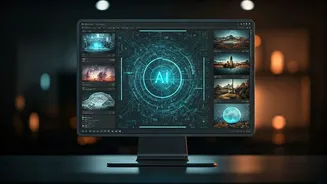
At their core, these are applications powered by generative artificial intelligence, the same technology behind platforms like ChatGPT and Midjourney. Instead of generating text, however, these tools specialise in creating images from written descriptions,
known as 'prompts'. For creative professionals, this means you can type a command like, “A minimalist living room with a large window, soft morning light streaming in, and a single monstera plant in the corner,” and the AI will generate multiple visual interpretations of that scene in seconds. These aren't stock photos; they are unique, newly created images that can serve as digital backdrops, storyboards, or lighting references for a project.
From Text Prompt to Virtual Set
The workflow is deceptively simple but requires a new kind of skill: prompt engineering. The user starts with a clear vision of the desired scene. The magic lies in the details. Instead of just asking for a 'beach', a professional might specify, “An empty Goan beach at sunset, with dramatic orange and purple clouds, calm waves, and long shadows from palm trees, shot with a wide-angle lens.” The AI model interprets these specific keywords—lighting conditions ('sunset'), location specifics ('Goan'), mood ('dramatic'), and even technical details ('wide-angle lens')—to produce a tailored image. This allows for rapid iteration. If the first concept isn’t right, you can tweak the prompt to adjust the colour palette, change the time of day, or add or remove elements until the visual concept is perfect. This process, which once took hours of searching for stock images or days of set construction, now takes minutes.
Key Players in the AI Space
While many tools can generate images, a few have become favourites among creatives for this purpose. Midjourney is renowned for its artistic and often hyper-realistic outputs, making it ideal for high-concept fashion and advertising visuals. Adobe Firefly, integrated directly into Photoshop, offers a massive advantage with its 'Generative Fill' feature. This allows a photographer to extend an existing backdrop or seamlessly add new elements into a photo they've already taken. Other tools like Stable Diffusion offer open-source flexibility for those with technical skills, while platforms like DALL-E 3 are known for their ability to follow complex prompts with high accuracy. For Indian creators, these tools provide access to global aesthetics and environments without the logistical nightmare of international travel or expensive set rentals.
The Game-Changer for Creatives
The impact of these tools on the creative industry is profound. For independent photographers and small advertising agencies in India, it democratises access to high-end production values. Pre-visualisation becomes incredibly fast and cheap; a director can generate dozens of lighting and set concepts to share with a client before a single piece of equipment is rented. This saves enormous amounts of time and money in the planning phase. Furthermore, for e-commerce brands, AI can generate an endless variety of lifestyle backgrounds for product mockups, allowing them to showcase items in different settings without costly photoshoots. It accelerates creativity by removing the friction between an idea and its first visual draft, leading to more ambitious and polished final products.
Beyond the Hype: Limitations and Concerns
Despite the excitement, these tools are not a magic bullet. The generated images often have flaws—strange artifacts, unrealistic physics, or the infamous 'AI hands' with too many fingers. High-resolution outputs suitable for large-scale printing can still be a challenge. More importantly, they cannot replicate the nuanced understanding of a professional set designer or photographer who brings years of experience in composition, light theory, and storytelling to a project. There are also significant ethical and legal questions around copyright, as many AIs were trained on vast datasets of existing images from the internet. For now, the technology is best viewed as a powerful assistant, not a replacement for human skill. The most effective use involves an artist guiding the AI to generate a strong base concept, which is then refined, composited, and finished using traditional skills and software.