




The Moon's Brutal Power Problem
Imagine a place where the 'day' is two weeks long, followed by a two-week night where temperatures plummet to minus 200 degrees Celsius. This is the reality at the Moon's South Pole, a key target for NASA's Artemis missions. For any piece of equipment—from
a scientific instrument to a rover or astronaut habitat—surviving this deep freeze is a monumental task. The lithium-ion batteries in our phones and cars rely on a liquid electrolyte to function. In the intense cold of the lunar night, this liquid would freeze solid, damaging the battery and rendering it useless. Furthermore, the vacuum of space can cause the liquid to evaporate. This means that without a new approach, lunar hardware would need heavy, power-hungry heating systems just to keep their batteries from destroying themselves, which dramatically limits what missions can accomplish.
A Solid-State Solution
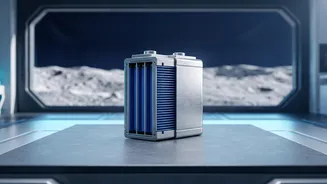
To solve this 'splashy problem', NASA researchers are developing a 'solid solution'. The project, called SPEARS (Solid Power for Extreme Environment Adaptability and Resilience in Space), is focused on solid-state batteries. These cells replace the vulnerable liquid electrolyte with a solid material, such as a ceramic or polymer. This fundamental change makes the batteries inherently more resilient to extreme temperatures. They don't have a liquid that can freeze, boil away, or pose the same fire hazards associated with traditional batteries. This innovation isn't just about survival; it's about efficiency. If batteries don't need constant heating, it frees up mass and power on a spacecraft for more science equipment or life-support consumables, a critical trade-off in mission design.
Real Progress in the Lab
Recent tests on small, prototype coin-cell batteries at NASA's Langley Research Center have delivered promising results. The SPEARS cells operated well in a thermal vacuum chamber at temperatures from 80°C down to minus 60°C. Critically, they continued to function with only slightly reduced performance all the way down to minus 80°C, a temperature far below the operational limit of conventional batteries. In an even more extreme test, the cells survived exposure to a temperature range from 100°C to minus 170°C without sustaining any physical damage. 'We proved for the first time that these cells can work down to minus 80 degrees Celsius,' said Yi Lin, the SPEARS testing and research lead at NASA Langley. This demonstrates that the core technology is robust enough to endure the journey through the lunar night.
The Long Road to 'Flight-Ready'
While this progress is significant, these batteries are far from being 'flight-ready'. It's important to distinguish between surviving the cold and operating in it. The prototypes did not generate power at the extreme low of minus 170°C; they simply endured it without breaking. To function again, they still require small heaters to warm them up to their operational range. The good news is that this 'wake-up' heating requires far less energy than constantly keeping a battery warm for 14 days. The next steps involve moving from small lab prototypes to building and qualifying complete battery packs. These packs must be rigorously tested for long-term durability, their ability to handle repeated charging cycles, and their resilience to the vibration and radiation of a space mission. NASA's Ames Research Center is now developing the flight hardware to test these batteries in space, a crucial step to prove they are ready for the Moon.